
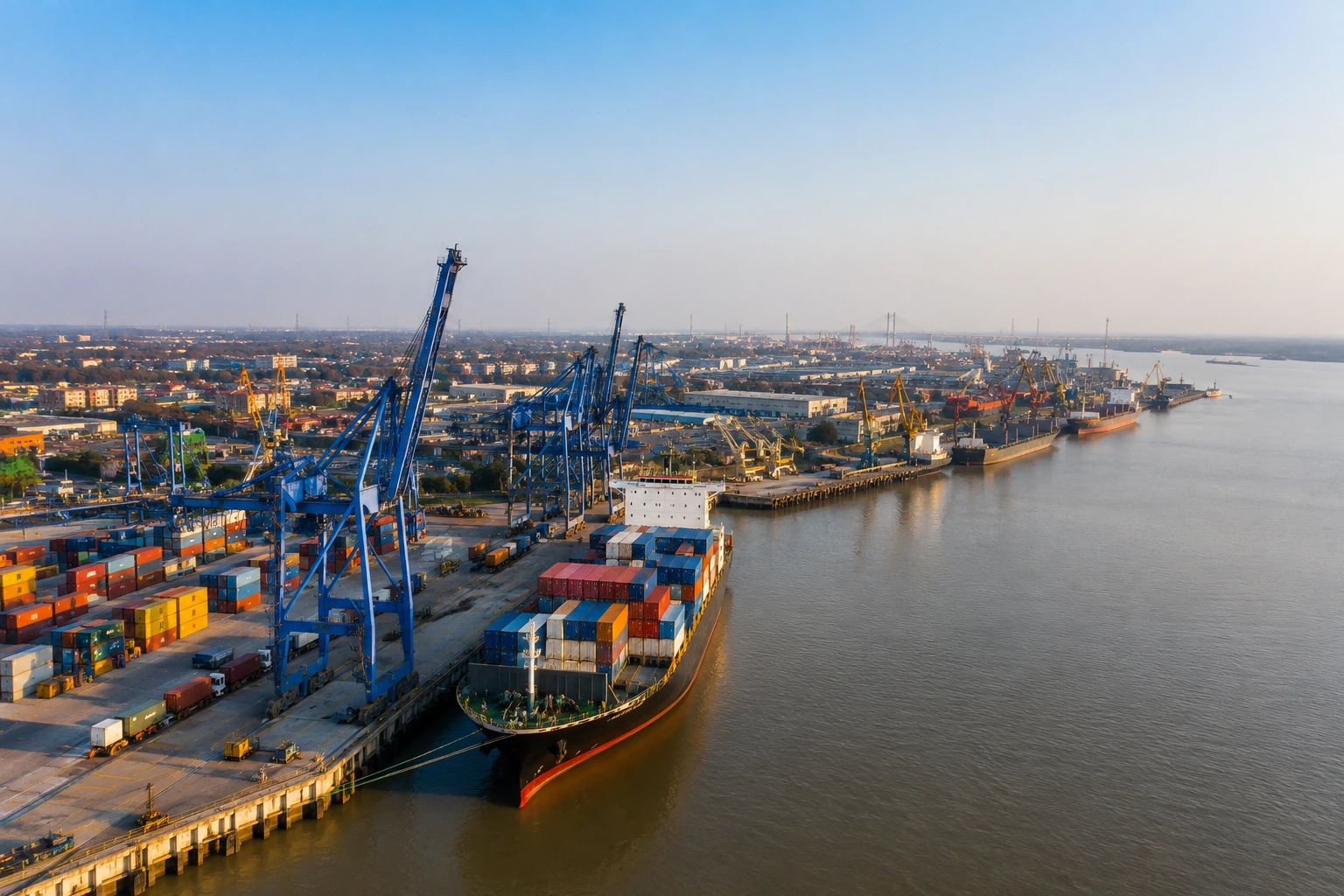
Adani Ports and Special Economic Zone Limited has officially commenced export-import operations at Kerala’s Vizhinjam International Seaport. The launch establishes a direct commercial gateway for Indian cargo, supported by a newly announced ₹160 billion expansion plan designed to elevate the port's capacity to 5.7 million TEUs by 2028.
India’s maritime infrastructure has reached a major operational milestone with the commencement of direct international trade activities at the country’s premier deep-water transshipment terminal. According to official disclosures, Adani Ports and Special Economic Zone Limited (APSEZ) has officially launched full-scale export-import (EXIM) operations at the Vizhinjam International Seaport in Kerala. The inaugural commercial consignment, consisting of frozen food products, was dispatched directly to Valencia, Spain. Adani Ports and Special Economic Zone Limited is India’s largest private port operator and a vertically integrated logistics company, managing a widespread network of deep-water ports and terminals along the Indian coastline. Concurrently, the state government introduced ‘Mission Samudra,’ a port-led industrial development initiative backed by a ₹4 billion catalytic fund designed to cultivate a comprehensive logistics and industrial ecosystem around the facility.
The transition of the Vizhinjam facility from a pure transshipment hub to an integrated commercial gateway fundamentally alters the logistics timeline for regional trade. Historically, international cargo from southern India required rerouting through foreign transshipment stops in Colombo, Dubai, or Singapore. Establishing direct inbound and outbound handling capabilities effectively bypasses these intermediate hubs, slashing maritime transit times to European markets from approximately sixty days down to twenty-four days. In conjunction with the EXIM launch, APSEZ committed an additional ₹160 billion in capital expenditure for the port's Phase 2 expansion. Targeted for completion by 2028, this investment aims to increase the facility's annual cargo handling capacity from 1.6 million twenty-foot equivalent units (TEUs) to 5.7 million TEUs, accompanied by 1,200 meters of additional container berth space.
From an industrial and macroeconomic perspective, the operationalization of Vizhinjam directly supports national strategic mandates for maritime self-reliance and global trade competitiveness. The concurrent launch of the Mission Samudra initiative highlights a coordinated policy effort to leverage port infrastructure as an anchor for regional economic development. The state-backed program is structured to cultivate eight industrial clusters and three new port cities along a 600-kilometer coastal corridor. By integrating dedicated road and rail connectivity with large-scale port operations, policymakers aim to drive extensive job creation and attract private manufacturing investments to the region.
For corporate exporters, shipping lines, and logistics operators, the availability of a deep-water domestic gateway offers transformative commercial advantages. Eliminating reliance on foreign transshipment nodes substantially lowers overall freight expenses and tightens supply chain turnaround times for critical export sectors across Kerala, Tamil Nadu, and Karnataka. As the ₹160 billion Phase 2 expansion advances, the surrounding commercial corridor is expected to see a surge in specialized real estate demand, creating immediate capital deployment opportunities across warehousing, cold storage, and integrated logistics parks.
About GlobeNewsInfo
GlobeNewsInfo.com is a business news platform providing latest updates on global business developments, projects, and contract opportunities across diverse sectors and regions. The platform is designed to serve as a trusted source of information for companies, investors, and professionals worldwide.