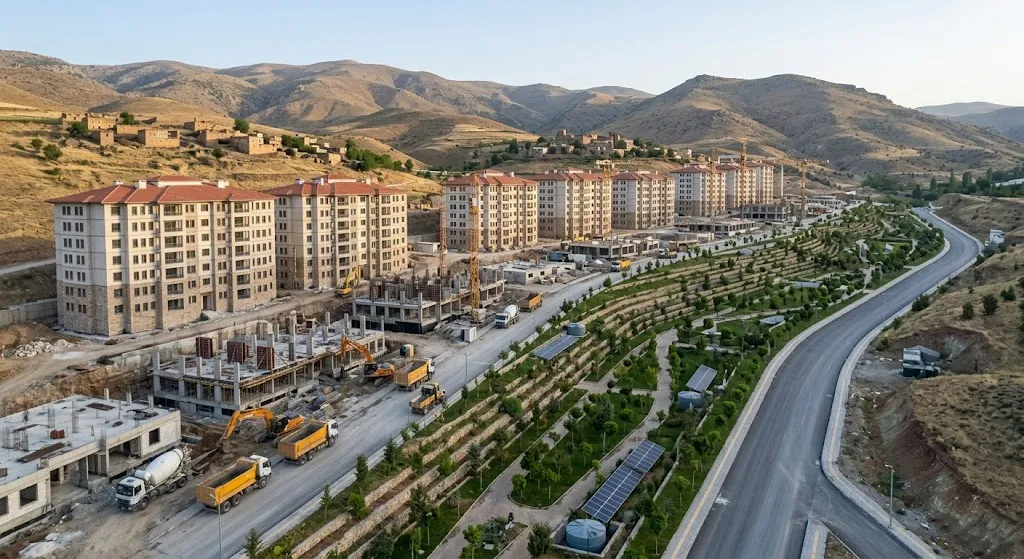
TURKEY —A $400 million financial facility has been issued to VakifBank by the Asian Development Bank (ADB) to support extensive reconstruction efforts and enterprise liquidity in regions severely impacted by the February 2023 seismic disasters in Turkiye. Half of the capital deployment is earmarked for residential developers to construct thousands of disaster-resistant and energy-efficient homes across eleven affected provinces. The remaining $200 million is structured to improve capital access for regional enterprises, prioritizing businesses that are female-owned, have strong female workforce participation, or are transitioning toward green technologies.
The strategic deployment of this capital addresses massive structural and economic deficits created by the natural disasters, which resulted in over a hundred billion dollars in physical damages and the destruction of hundreds of thousands of residential units. VakifBank, which operates as Turkiye's second-largest bank by assets and functions as a major state-owned financial institution, will utilize its extensive nationwide network to distribute these funds. The Asian Development Bank (ADB), a prominent international institution established to foster sustainable economic advancement and resilience across its member states, aims to mitigate long-term economic shocks through this targeted structural intervention.
The broader macroeconomic environment in Turkiye features a significant commercial financing shortfall, estimated at over $140 billion, which severely restricts operations for smaller enterprises that make up the vast majority of commercial entities in the country. By funneling long-term capital directly into provincial markets, the initiative reduces the immediate financial constraints on structural developers and local commercial operators. Furthermore, the conditional focus on renewable energy adoption and adaptive infrastructure signifies a pivotal shift in regional development policy, incentivizing contractors and commercial borrowers to adhere to enhanced environmental and structural resiliency standards.
For investors and regional stakeholders, this targeted capital allocation creates immediate contracting opportunities within the construction and sustainable technology sectors. Developers engaging in disaster-resistant residential projects will benefit directly from the improved liquidity pipeline. Additionally, the mandate to integrate a female-inclusive framework into corporate lending operations establishes new compliance and reporting metrics for commercial borrowing, potentially setting a precedent for future institutional financing in emerging markets. The overarching strategy ensures that recovery capital not only replaces lost infrastructure but fundamentally modernizes the regional economy to withstand future environmental and economic volatility.