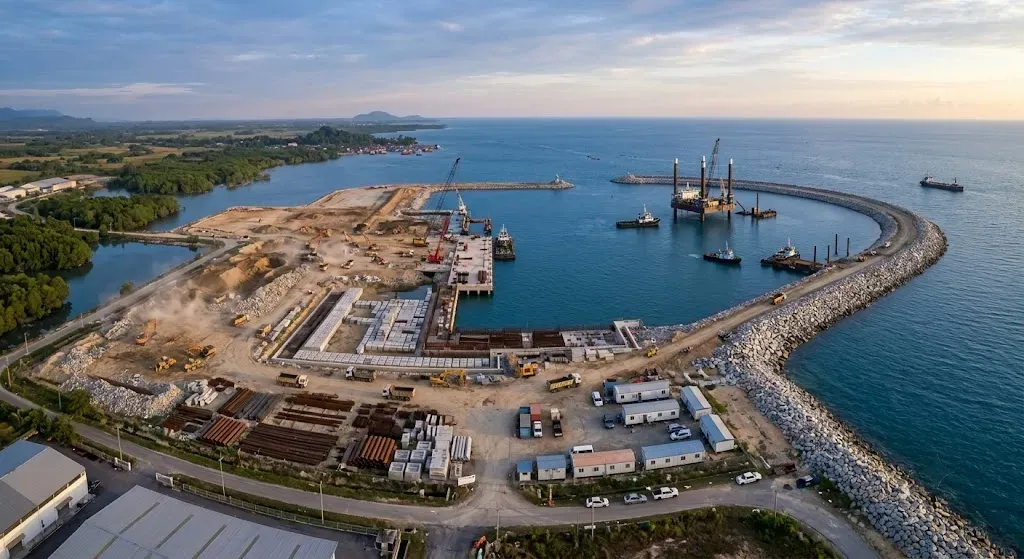
MALAYSIA —Berjaya Construction Berhad has been commissioned to undertake the design-and-build engineering mandates for the Sanglang Port development initiative located in Perlis, Malaysia. Backed by an aggregate capital outlay of approximately RM1.2 billion, which includes initial construction estimates reaching RM675 million, the project is structured to unfold in sequential phases. The foundational blueprint outlines the establishment of dual multi-user terminals, a dedicated Roll-on/Roll-off facility, and a general cargo terminal spanning a four-kilometer trestle featuring water depths up to 11.9 meters. Operations will address diverse commercial requirements encompassing fisheries, bulk commodities, petroleum logistics, and liquefied petroleum gas handling. Berjaya Construction Berhad operates as a wholly-owned subsidiary specializing in civil engineering, building construction, and public utility infrastructure delivery.
This strategic maritime expansion addresses critical infrastructural bottlenecks in northern Peninsular Malaysia by providing an ocean-bound outlet that directly complements inland logistics nodes, specifically the Perlis Inland Port and the Chuping Valley Industrial Area. By establishing round-the-clock Roll-on/Roll-off connectivity toward Langkawi alongside dedicated energy and industrial terminals, the project bridges geographical disparities and expands export-import pathways. The initiative aligns with broader state ambitions to establish comprehensive energy and power hubs, reinforcing the region's long-term utility capacity. Such maritime enhancements directly elevate the competitive standing of domestic supply chains and optimize cross-border freight corridors interfacing with neighboring international markets.
The venture carries profound implications for the logistics, maritime transport, heavy engineering, and energy sectors operating across Southeast Asia. Industrial stakeholders and manufacturing enterprises situated within northern economic corridors gain accelerated access to international shipping lanes, substantially lowering transit overheads. Policy architects and regional authorities anticipate that the infrastructure will catalyze downstream commercial investments, stimulate local employment generation, and mitigate economic imbalances between northern territories and central industrial centers. Furthermore, establishing specialized liquefied petroleum gas and energy landing zones positions the state to capture emerging energy sector investments.
For corporate entities and capital markets, the undertaking underscores the growing valuation of integrated logistics assets that merge inland rail parks with deep-water maritime interfaces. Engineering, procurement, and construction contractors face heightened expectations to deliver complex multi-modal terminals within strict budgetary and scheduling parameters, exemplified by the targeted thirty-month timeline established for the primary trestle phase. Investors tracking infrastructure portfolios should monitor regulatory approvals and construction milestones, as successful execution will validate the economic viability of pairing inland free commercial zones with coastal port facilities to unlock secondary industrial growth corridors.