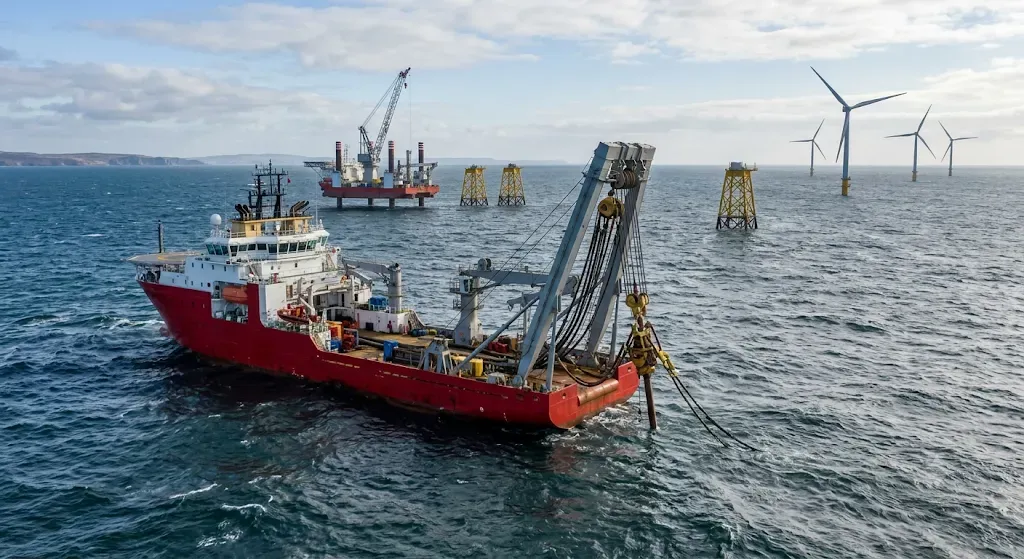
GERMANY —The German Federal Maritime and Hydrographic Agency (BSH) has formally appointed Fugro to execute a multiyear framework program focused on marine geotechnical site characterization within the German North Sea sector. Under the terms of the agreement, operations will encompass advanced offshore data collection utilizing specialized drilling platforms and seabed testing assets, alongside comprehensive laboratory analyses conducted across multiple European facilities.
This contractual arrangement directly addresses the growing need for reliable subsurface intelligence to support complex marine renewable energy infrastructure. By establishing standardized baseline data ahead of formal commercial bidding and construction phases, the initiative mitigates pre-development risks and reduces appraisal timelines for future greenfield assets. The German Federal Maritime and Hydrographic Agency (BSH) operates as a central federal authority handling maritime responsibilities, hydrographic surveying, and offshore spatial planning, while Fugro functions as a prominent global geodata specialist providing offshore survey, geotechnical, and geoscience services.
The procurement decision carries substantial operational ramifications for the European offshore wind sector, particularly regarding regulatory compliance and site preparation standards. Navigational safety and foundation design heavily rely on precise soil mechanics and stratigraphic modeling, making rigorous baseline assessments indispensable for project viability. Engineering, procurement, and construction contractors, alongside regional environmental regulators, benefit from streamlined access to standardized geological repositories that inform engineering tolerances and structural parameters.
For market participants, institutional investors, and project developers, framework awards of this nature offer enhanced visibility and operational continuity across multi-phase regional buildouts. Securing guaranteed investigative capacity helps safeguard project pipelines against logistical bottlenecks and inflationary pressures associated with specialized vessel availability. Furthermore, centralized site characterization lowers individual developer overhead during early bidding stages, fostering a more competitive market environment for clean energy deployment.