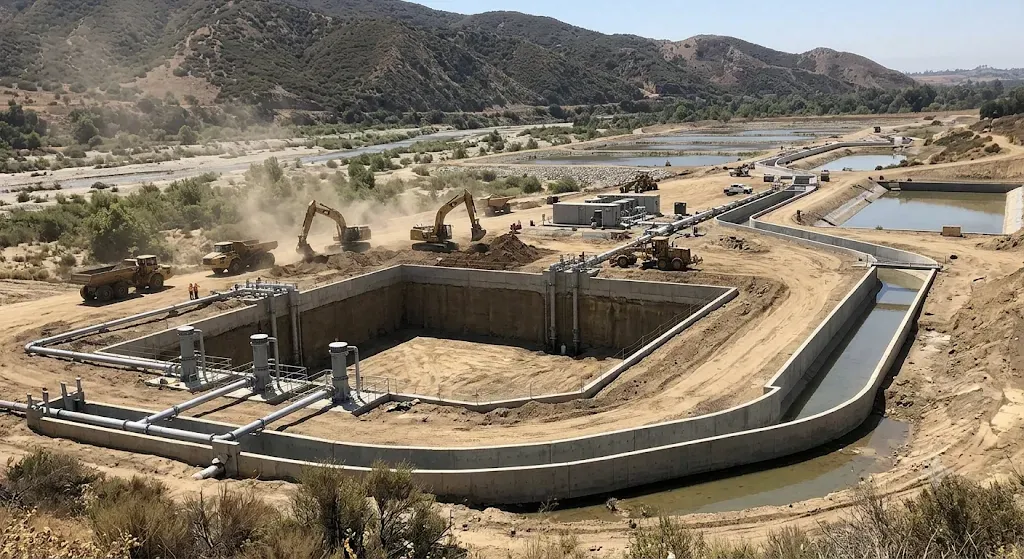
UNITED STATES OF AMERICA —The California Department of Water Resources (DWR) has finalized a USD 55 million financial disbursement aimed at expanding water storage capabilities and modernizing supply networks in Southern California. The capital allocation supports completed development phases under the Santa Ana River Conservation and Conjunctive Use Program, a collaborative watershed initiative involving the Santa Ana Watershed Project Authority (SAWPA) and associated municipal water districts. The program integrates regional infrastructure to optimize liquid asset management across San Bernardino Valley basins.
This capital deployment addresses long-term resource scarcity driven by shifting climatic patterns, extended drought cycles, and irregular precipitation trends across the state. By financing the construction of regional conveyance pipelines, subsurface extraction wells, and engineered recharge basins, the initiative provides municipal authorities with the physical connectivity required to capture surplus surface runoff during wet periods and secure sub-surface reserves for future dry cycles. The California Department of Water Resources (DWR) operates as a state agency responsible for managing, protecting, and developing California's water resources. The Santa Ana Watershed Project Authority (SAWPA) functions as a joint powers authority representing regional water districts to manage watershed resources effectively.
The completed improvements directly influence public utility operators, regional municipal utility districts, and environmental management sectors operating within the Southern California economic zone. Regional water agencies gain heightened operational flexibility, enabling coordinated storage and inter-agency resource exchanges that stabilize municipal and agricultural supply chains. The integration of advanced subterranean capture facilities mitigates vulnerability to supply shocks during prolonged dry periods, safeguarding local economic stability and commercial activities reliant on steady utility access.
For corporate entities, institutional investors, and municipal bondholders, this capital injection underscores the expanding market for climate-resilient civil engineering and sustainable resource management assets. Increased public spending on subterranean recharge networks and conveyance systems signals robust regulatory backing for infrastructure modernization, creating predictable revenue pipelines for engineering, procurement, and construction contractors. Furthermore, enhanced supply security reduces operational risks for commercial enterprises reliant on heavy water consumption, insulating regional industrial markets from regulatory curtailments during severe weather anomalies.