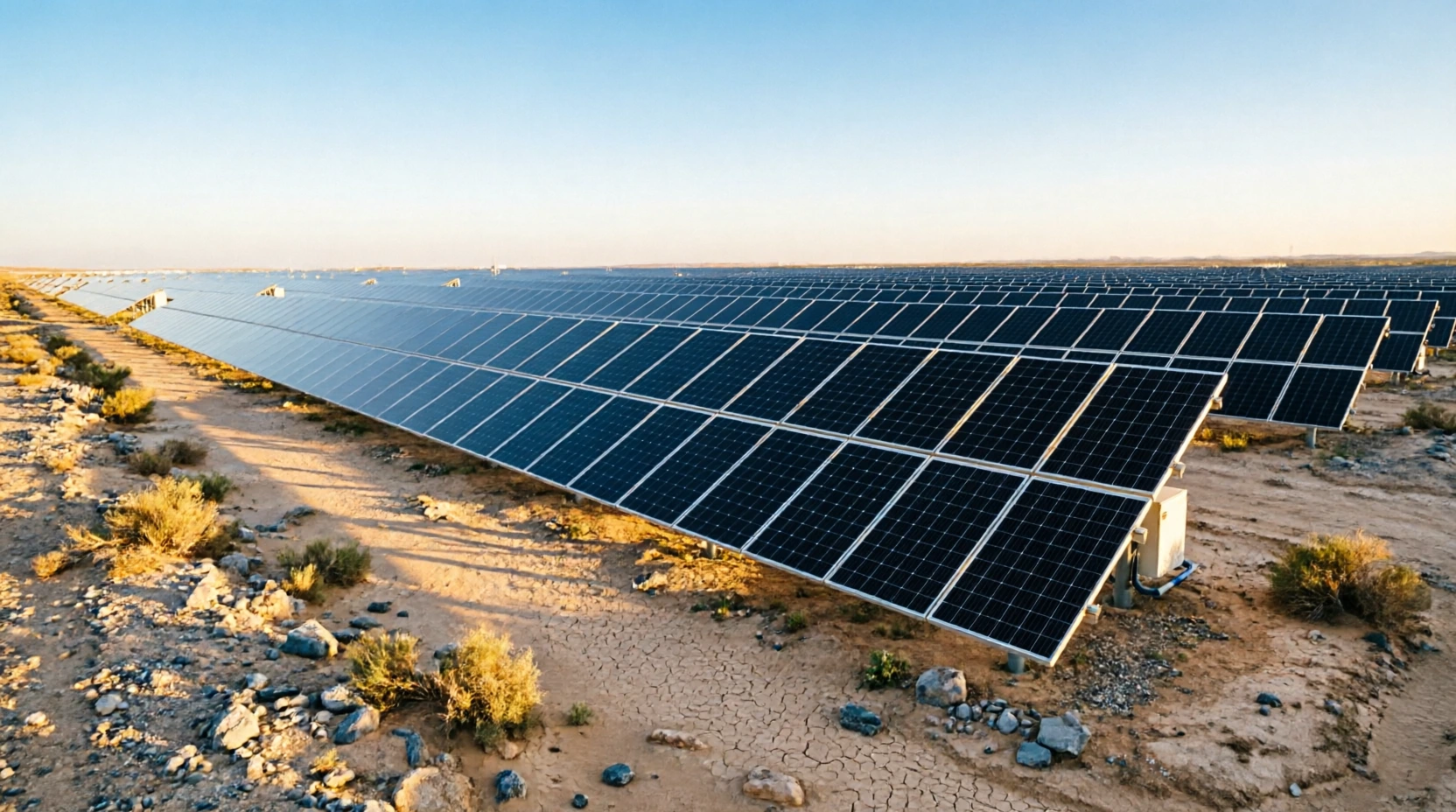
INDIA —Clean energy supply to northern India received a substantial boost on November 21, 2026, as Deshraj Solar Energy initiated commercial power generation across 147 MW of its utility-scale photovoltaic installation in Rajasthan. Situated at Karnisar Bhatiyan village within the Bikaner district, the operationalized segment represents 98% of a planned 150 MW solar park. The asset feeds electricity directly into the national transmission network through the Bikaner-III substation managed by Power Grid Corporation of India, following trial run certification granted on November 19 by the Northern Regional Load Despatch Centre under Grid Controller of India.
Operationalizing nearly the entire planned capacity reinforces India's broader renewable energy transition while demonstrating execution efficiency within Rajasthan's high-irradiance solar corridor. For regional power utilities and industrial off-takers across the northern grid, the addition of 147 MW of clean generation enhances daytime load management and supports compliance with renewable purchase obligations. Furthermore, seamless synchronization with central transmission infrastructure underscores ongoing progress in resolving evacuation bottlenecks that historically delayed utility-scale solar deployments in western India.
Deshraj Solar Energy operates as a step-down subsidiary of CESC, a Kolkata-headquartered integrated power utility engaged in electricity generation and distribution across multiple Indian states. Power Grid Corporation of India serves as the country's central transmission utility, responsible for developing and operating high-voltage inter-state power transfer networks, while Grid Controller of India oversees real-time system operations and grid reliability across regional load despatch centers.
From an industry and policy standpoint, bringing large-scale solar assets online within scheduled timelines aligns closely with national energy security mandates aimed at reducing thermal power dependency. The Bikaner-III pooling station continues to emerge as a critical node for interstate green energy transmission, enabling power generated in desert regions to serve commercial and residential demand centers across northern states without localized grid congestion.
For equity investors and energy sector analysts, the commissioning converts capital work-in-progress into active revenue-generating infrastructure for CESC. Following the operational milestone, CESC shares settled 0.6% higher at ₹127.7 on the National Stock Exchange during the preceding trading session on November 20. Management has outlined a clear timeline to bring the remaining 3 MW balance capacity online by January 31, 2027, which will complete the 150 MW facility and optimize overall plant load factors and asset returns.