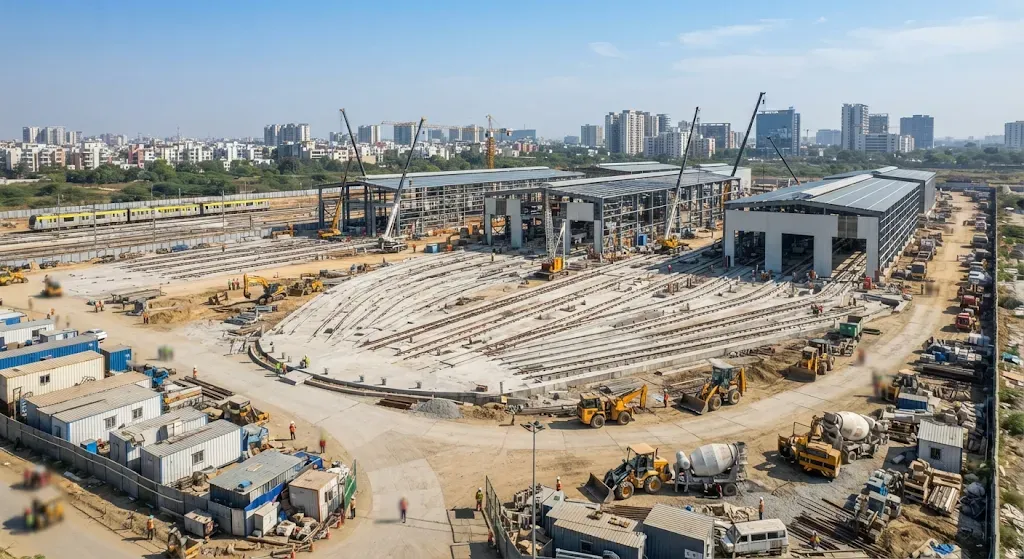
INDIA —Dilip Buildcon has been issued a Letter of Acceptance by Gurugram Metro Rail Limited (GMRL) for a contract valued at INR 4.19 billion, inclusive of goods and services tax. The assignment covers building a depot cum workshop facility-encompassing civil, architectural, and electrical and mechanical works-for the elevated Gurugram Metro corridor at Sector 33 in Haryana, India. Executed on an item-rate basis, the work carries a 21-month completion timeline.
Dilip Buildcon is an Indian infrastructure development and construction enterprise headquartered in Bhopal, Madhya Pradesh, executing projects across transport and urban engineering. Gurugram Metro Rail Limited (GMRL) serves as the public transit authority overseeing metro rail expansion in Gurugram, Haryana.
Dedicated maintenance depots and workshops are foundational to rail transit reliability because they enable routine servicing, rolling stock readiness, and operational scaling before passenger corridors enter full service. Awarding civil, architectural, and electrical and mechanical packages together streamlines interface coordination across structural and system installations on a major urban mobility corridor.
Within Haryana's urban transport landscape, the Sector 33 facility supports broader regional connectivity in the National Capital Region (NCR) and highlights continued public capital deployment into metropolitan rail assets. For engineering, procurement, and construction contractors, metro rail depots represent specialized urban infrastructure work that bridges structural civil execution with building services and mechanical systems.
For institutional observers and market participants, the mandate adds multi-quarter revenue visibility for Dilip Buildcon over a nearly two-year execution window under an item-rate structure, where final billing tracks measured quantities of work performed. Delivery discipline across civil, architectural, and electrical and mechanical trades over the 21-month schedule will be a key operational benchmark as Gurugram's elevated transit network advances.