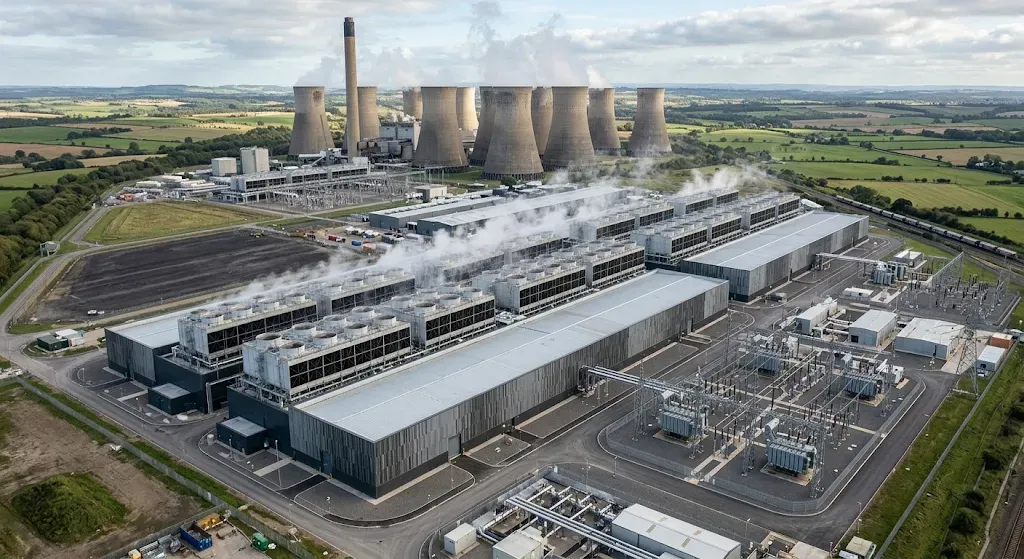
UNITED KINGDOM —Drax Group, Brookfield, and Radiant have established a strategic alliance to develop, operate, and deliver gigawatt-scale data centre infrastructure at the Drax Power Station in North Yorkshire. Backed by the Brookfield-Qai joint venture, the multi-phase development anticipates total capital expenditure exceeding £20 billion. The initial phase targets up to 100 MW of capacity, supported by an estimated £2.5 billion in funding, with operations slated to commence in the first quarter of 2028. Subsequent phases aim to expand capacity to 500 MW by 2031, with further extensions planned thereafter, contingent upon regulatory approvals and tenant acquisition.
Drax Group is a prominent United Kingdom-based energy company, recognized as the nation’s largest single source of renewable electricity by output. The organization operates a diverse portfolio of flexible, low-carbon power assets, including biomass, hydro, and solar generation. Radiant serves as a vertically integrated artificial intelligence infrastructure platform headquartered in the UK, while Qai is a global technology firm based in Qatar focused on scaling AI deployment.
This development addresses a critical bottleneck in the United Kingdom’s digital expansion: the convergence of reliable, large-scale power and advanced compute infrastructure. The Drax site offers 1,000 acres of land, 4 GW of grid access, and 2.6 GW of active dispatchable generation, alongside existing cooling systems and proximity to national fibre networks. By repurposing an established energy asset, the consortium mitigates the prolonged timelines typically associated with securing new power connections for hyperscale facilities.
The initiative aligns directly with recent governmental frameworks, including the newly introduced Data Centre Covenant, which seeks to accelerate planning and power access for strategically vital digital infrastructure. Stakeholders across the energy, technology, and public sectors view this collaboration as a mechanism to reinforce national artificial intelligence sovereignty. Furthermore, the partners have committed to establishing a voluntary community benefits fund, initiating local consultations to ensure regional economic alignment alongside formal planning submissions.
For investors and enterprise technology stakeholders, this alliance signals a maturing market for co-located power and compute assets. The integration of legacy energy infrastructure with next-generation artificial intelligence demands creates a defensible competitive advantage, attracting institutional capital seeking long-term, utility-grade returns. This model may catalyze similar repurposing initiatives across other industrial sites in the United Kingdom, positioning the region as a competitive destination for global technology investment while supporting domestic reindustrialisation agendas.