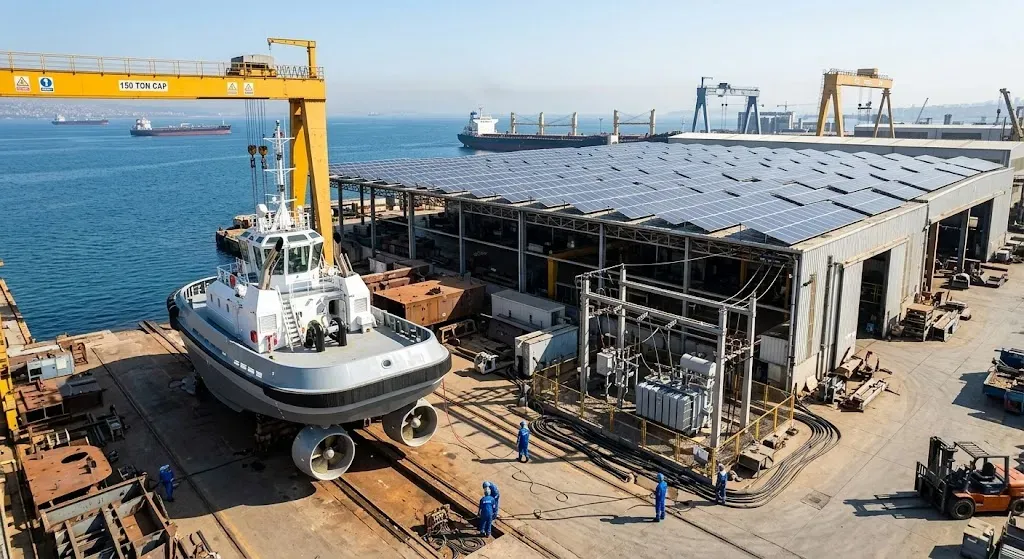
TURKEY —Sanmar Denizcilik Makina ve Ticaret has secured a comprehensive funding package totaling €45 million, arranged by Akbank, to accelerate its manufacturing expansion and sustainability initiatives. The funding structure incorporates a €22.5 million loan provided by the European Bank for Reconstruction and Development (EBRD) under a risk-sharing partnership designed to stimulate sustainable industrial growth. Founded in 1976, Sanmar is a Turkish shipbuilder specializing in advanced commercial vessels, including liquefied natural gas-fuelled and autonomous craft. The capital injection is directed toward scaling the production and delivery capacity for fully electric tugboats, aligning operations with stricter environmental mandates across international shipping routes. In addition to vessel manufacturing, the financial agreement includes a €5 million uncommitted tranche allocated for constructing a 5 MW solar photovoltaic power facility intended to cover corporate electricity needs.
This capital allocation addresses the rising demand for low-carbon maritime infrastructure as regulatory pressures mount on commercial shipping fleets to curtail greenhouse gas emissions. Traditional maritime operations remain heavily reliant on diesel propulsion, generating substantial carbon footprints across global trade corridors. By shifting production focus toward zero-direct-emission electric vessels, the initiative tackles emissions directly at the manufacturing and operational levels. Furthermore, embedding renewable energy generation into the enterprise footprint reduces operational vulnerability to conventional energy price volatility while lowering overall corporate emissions.
The broader maritime manufacturing sector, clean energy technology providers, and regional commercial banking networks experience direct operational relevance from this development. Shipbuilding enterprises face accelerating mandates to transition product portfolios toward electrified or alternative-fuel propulsion systems to retain market competitiveness. Financial institutions increasingly tie commercial lending terms to strict environmental, social, and governance metrics, reshaping risk assessment frameworks for industrial manufacturing. Regional economies with established shipbuilding clusters observe heightened pressure to adopt green manufacturing processes to align with international climate frameworks.
Corporate decision-makers and industrial investors must factor accelerating decarbonisation timelines into long-term capital allocation strategies, particularly within heavy industries facing high abatement costs. Access to structured blended finance and risk-sharing mechanisms serves as a critical catalyst for maritime technology developers attempting to scale capital-intensive green assets. Stakeholders monitoring maritime assets should anticipate continued convergence between commercial lending facilities and environmental performance benchmarks as regulatory scrutiny intensifies globally.