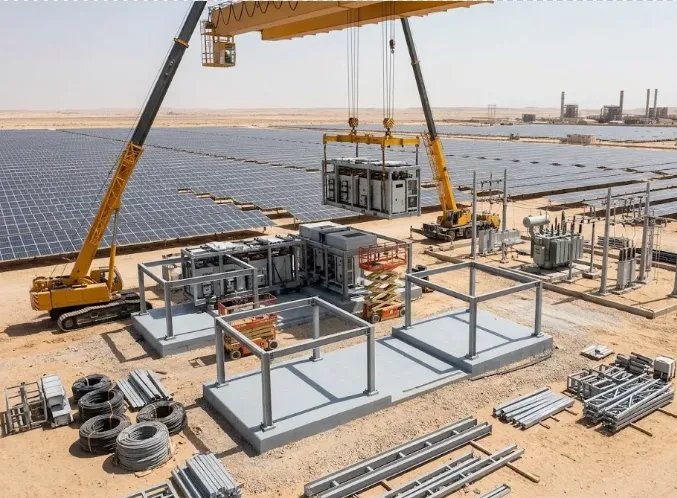
EGYPT —The European Bank for Reconstruction and Development (EBRD) is providing US$63 million in financing to Dandara Solar Power for the development of a 500 MW solar photovoltaic facility integrated with a 100 MWh battery energy storage system in the Nagaa Hammadi region of Egypt. The project is designed to supply renewable electricity directly to Misr Aluminium Company (EgyptAlum), one of the country's major industrial electricity consumers, under a 25-year power purchase agreement (PPA). Electricity will be transmitted through Egypt's national grid.
The financing package includes US$10 million in concessional funding from the Climate Investment Funds (CIF) and US$7 million contributed by Canada through the EBRD's High-Impact Partnership on Climate Action. The African Development Bank (AfDB) and European Investment Bank (EIB) are also participating in the project's financing. Scatec, a Norwegian renewable energy developer and power producer, is the project's main sponsor and will oversee its development.
Once operational, the facility is expected to generate approximately 1,470 GWh of renewable electricity annually, equivalent to the consumption of more than 300,000 households. It is also projected to prevent nearly 732,000 tonnes of carbon dioxide emissions each year. The integrated battery system will store electricity generated during daylight hours and release it during periods of higher demand, helping address the intermittency of solar generation and improving the reliability of electricity supply.
The development addresses two interconnected challenges facing Egypt's economy: growing industrial electricity requirements and the need to reduce dependence on fossil-fuel-based generation. Securing renewable electricity through a long-term supply agreement could provide EgyptAlum with greater visibility over its energy sourcing and reduce its exposure to fluctuations in conventional energy markets. This is particularly relevant for energy-intensive aluminium production, where electricity costs and carbon intensity influence operating economics and international competitiveness.
The project's implications also extend to Egypt's industrial export sector. Access to lower-carbon electricity could strengthen the environmental credentials of domestically produced aluminium, particularly for manufacturers serving international markets with increasingly stringent carbon disclosure and emissions requirements. The investment is being implemented under the energy pillar of Egypt's Nexus of Water, Food and Energy (NWFE) programme, which seeks to accelerate private-sector participation in renewable energy development.
Alongside infrastructure development, the investment incorporates a workforce training programme in Qena Governorate. At least 100 participants will receive nationally accredited training in green and digital skills, with women expected to represent a minimum of 25% of trainees. Scatec will additionally provide up to five annual internships for programme graduates, linking the project to local employment and technical workforce development.
For investors and businesses, the transaction demonstrates the growing role of blended development finance in supporting large-scale renewable infrastructure in emerging markets. Combining institutional lending with concessional capital can improve project financing conditions while attracting private-sector participation. The integration of battery storage with industrial power supply also provides a potential model for similar arrangements involving energy-intensive manufacturers across the region.
The EBRD is an international financial institution that finances private-sector development, sustainable infrastructure and economic transformation across its countries of operation. It began investing in Egypt in 2012 and has committed €16.1 billion to projects in the country. Scatec develops, builds and operates renewable energy assets, including solar, wind and energy storage projects, across international markets.