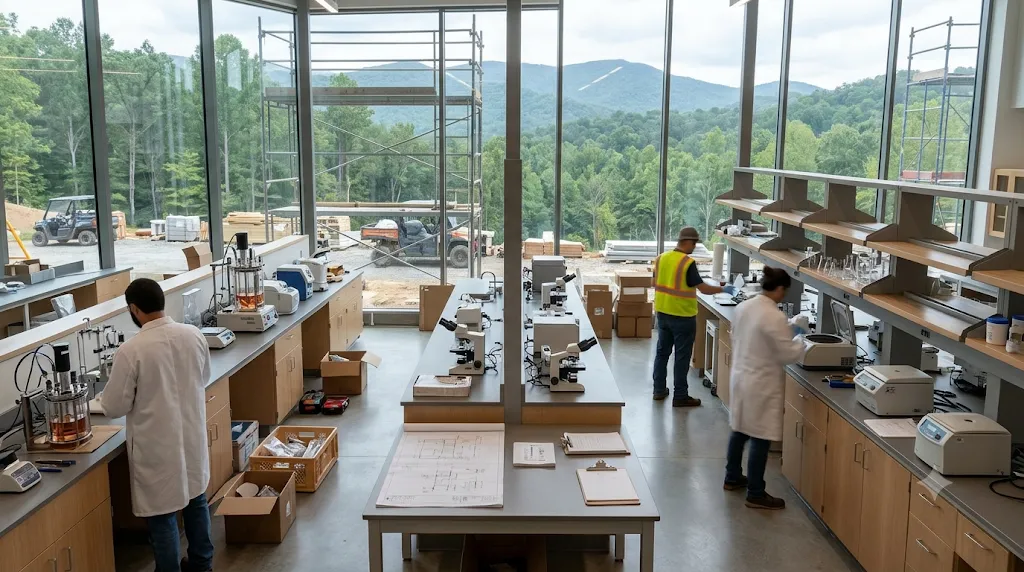
UNITED STATES OF AMERICA —The US Department of Commerce announced on November 19, 2026, that the Economic Development Administration (EDA) intends to award $33.2 million in disaster supplemental funding to the Western North Carolina Life Sciences Cluster. Supported by $18.8 million in additional commitments, the capital will fund laboratory and industrial facilities designed to advance startup commercialization and expand workforce training across the healthcare and medical technology sectors. The planned grant responds to economic disruption from Hurricane Helene in 2024 and is allocated under the Industry Transformation Pathway of the EDA Fiscal Year 2025 Disaster Supplemental Grant Program, a $1.45 billion federal fund supporting communities affected by federally declared natural disasters in 2023 and 2024.
Directing disaster recovery funding into specialized life sciences infrastructure reflects a strategic shift from asset replacement toward structural economic modernization. Rather than restricting aid to rebuilding storm-damaged property, the $33.2 million federal allocation alongside $18.8 million in partner commitments aims to anchor higher-wage medical and biotech industries in Western North Carolina. At the federal level, the investment supports broader industrial policy goals aimed at reducing US reliance on foreign pharmaceutical supply chains and returning medical research and development to domestic locations.
Operating within the US Department of Commerce, the EDA leads federal regional economic development initiatives by funding infrastructure, innovation ecosystems, and post-disaster recovery projects to boost domestic competitiveness and employment. Its Industry Transformation Pathway deploys large-scale grants to accelerate the growth of new or existing sectors through coordinated regional projects. The intended recipient, the Western North Carolina Life Sciences Cluster, is a regional initiative working to establish specialized facilities, commercialization support, and technical career pipelines for healthcare and medical technology enterprises across western North Carolina.
The funding carries significant operational implications for biopharmaceutical firms, medical device developers, commercial construction contractors, and regional educational institutions across North Carolina and the broader Appalachian corridor. By pairing dedicated laboratory and industrial capacity with structured workforce training, the project addresses two structural barriers facing non-metropolitan biotech markets: limited wet-lab space and shortages of specialized technical labor. From a policy standpoint, the award illustrates how federal disaster recovery programs are increasingly deployed to build competitive industry clusters outside traditional metropolitan hubs such as North Carolina's Research Triangle.
For institutional investors, venture-backed life sciences startups, and corporate site-selection executives, the federally anchored hub lowers capital entry barriers into a lower-cost regional market while signaling sustained public support for domestic medical reshoring. Engineering firms, laboratory equipment vendors, and commercial developers are positioned to capture buildout demand as facilities progress from planning to construction. Longer term, private investors evaluating domestic biomanufacturing and medical technology expansion may view grant-backed regional clusters as de-risked operating environments with emerging talent pipelines and co-investment alignment.