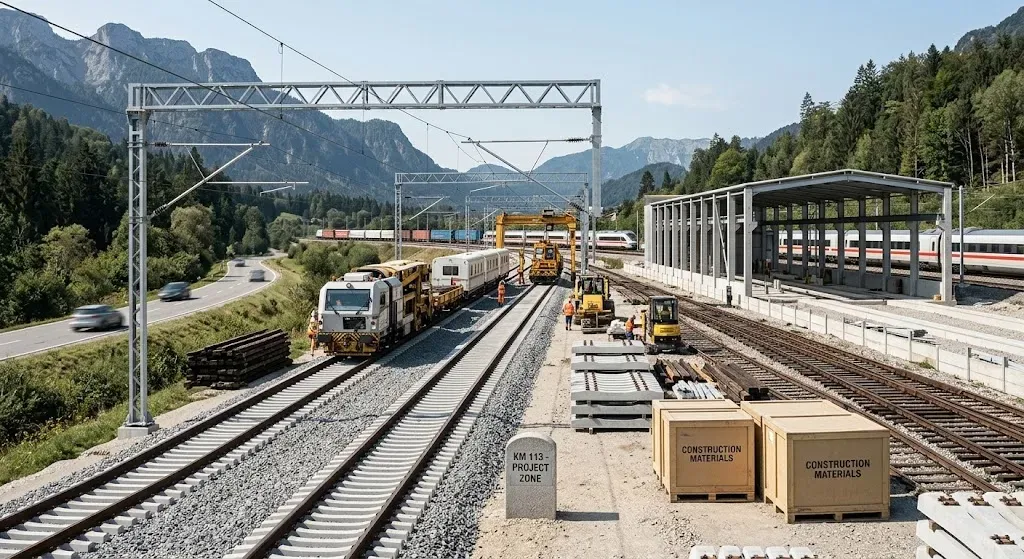
ROMANIA —A strategic financing agreement has been finalized to upgrade 113 kilometers of double-track, electrified railway infrastructure situated in central Romania between the cities of Brașov and Sighișoara. The initiative carries an overall estimated project expenditure of EUR 2.25 billion, incorporating funding from European Union instruments alongside national state contributions. The European Investment Bank (EIB) has committed EUR 630 million toward this capital expenditure. Established in 1958 under the Treaty of Rome, the European Investment Bank (EIB) functions as the long-term lending institution of the European Union, owned by its member states, to finance projects that achieve EU policy objectives.
The modernization program targets key physical and operational constraints along critical European transport routes, specifically designated elements of the Rhine-Danube and Baltic Sea-Black Sea-Aegean Sea corridors. Upon completion, the corridor will accommodate passenger train velocities up to 160 kilometers per hour and freight operations reaching 120 kilometers per hour. System capacity is projected to handle up to 29 passenger and 22 freight train movements daily, facilitating an estimated annual volume of 4 million passengers and 6 million metric tons of freight. Furthermore, the installation of the European Rail Traffic Management System Level 2 aims to bolster operational safety and cross-border network interoperability.
This infrastructure overhaul directly impacts the rail, logistics, and civil engineering sectors by removing persistent transit bottlenecks and integrating regional networks with wider continental supply chains. Regional economies stand to gain from enhanced passenger mobility and heavier freight payload limits, which collectively support broader industrial competitiveness. The initiative also advances environmental policy goals by incentivizing modal shift from highway transport to rail networks, thereby mitigating congestion, fossil fuel dependency, and carbon emissions across southeastern Europe.
For industrial investors and commercial enterprises, the long-term market implications include more reliable logistics channels, reduced transit times, and improved supply chain resilience across Central and Eastern Europe. The integration of high-performance rail assets supports regional economic cohesion by connecting key industrial hubs to larger continental markets. Additionally, advisory support deployed alongside the capital allocation ensures adherence to stringent technical specifications for interoperability, minimizing project execution risks for stakeholders engaged in large-scale transport infrastructure development.