LITHUANIA —The European Investment Bank (EIB) has signed a €100 million financing agreement with the Klaipėda State Seaport Authority to support a comprehensive modernisation programme at Lithuania’s principal seaport. The loan will fund upgrades that simultaneously strengthen military mobility capabilities, expand clean-energy infrastructure and improve facilities for offshore wind operations across the Baltic region.
The European Investment Bank (EIB) is the European Union’s long-term lending institution, owned by the 27 Member States and focused on projects that advance EU policy priorities including climate action, cohesion and security. The Klaipėda State Seaport Authority is the state-owned entity responsible for managing, developing and maintaining Lithuania’s only seaport, coordinating infrastructure, navigational safety and commercial operations.
The overall investment package is valued at approximately €201 million, with the EIB covering up to half the cost. Remaining funds are expected from European Union sources, national budgets and other institutional partners. Works encompass adaptation of civilian cruise terminal elements to accommodate allied naval vessels, installation of shoreside electricity for ferries, green-hydrogen production and refuelling facilities, low-emission port craft, reinforced quays suitable for offshore wind support, dredging and strengthened breakwaters. Full completion is targeted for the end of 2027.
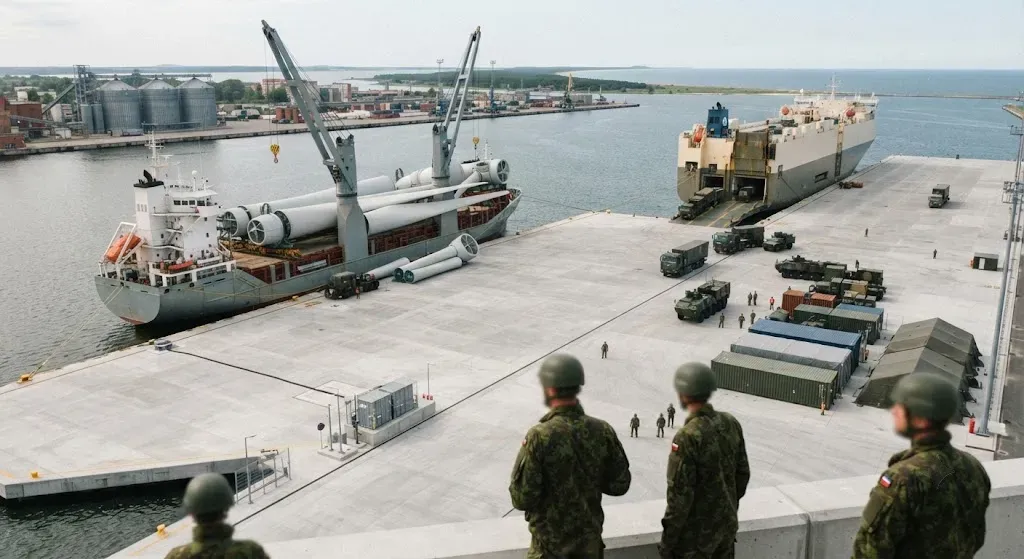
This development carries strategic weight because Klaipėda occupies a critical position on NATO’s eastern flank and forms part of the EU’s core Trans-European Transport Network. Dual-use infrastructure allows the same assets to serve both commercial shipping and allied military logistics, improving rapid-response capacity without duplicating civilian facilities. Stakeholders include the Lithuanian government, NATO allies, regional energy developers and Baltic trade operators who rely on reliable maritime access.
In the defence domain the project supports enhanced logistical readiness for allied naval vessels while preserving commercial throughput. Energy-sector impacts centre on enabling more efficient deployment and maintenance of offshore wind farms, thereby contributing to regional renewable capacity and reduced dependence on imported fuels. Port operators, construction contractors and clean-technology suppliers stand to benefit from the capital works, while local economies gain from sustained maritime activity and associated employment.
For businesses and investors the financing signals continued official backing for dual-use transport assets that align security and decarbonisation objectives. Companies active in offshore renewables, green-hydrogen supply chains and specialised port engineering may find expanded opportunities in the Baltic market. The investment also reinforces Klaipėda’s competitiveness as a multimodal logistics node linking northern European corridors, potentially improving resilience of regional supply chains against geopolitical and climate-related disruptions.