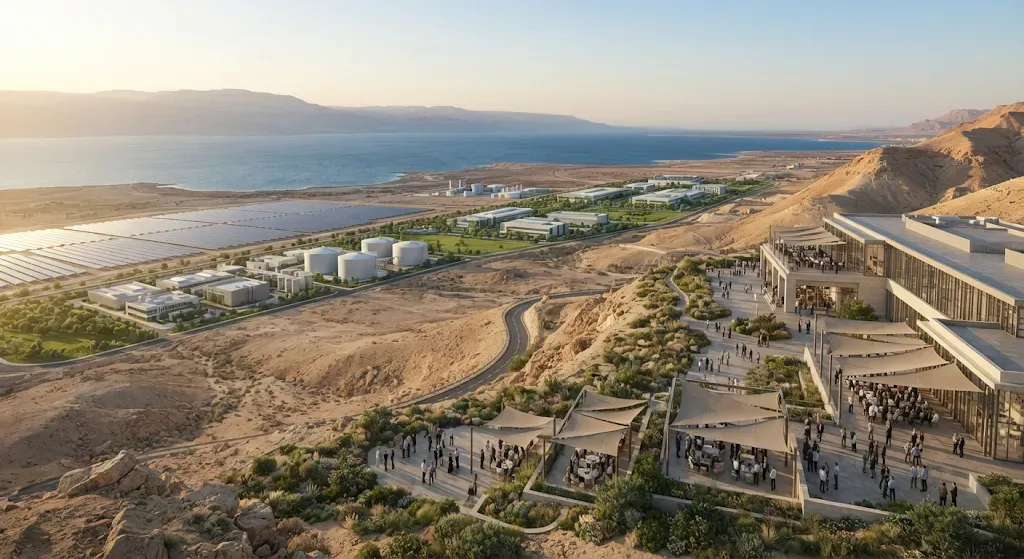
JORDAN —During the EU-Jordan Investment Conference at the Dead Sea, European Commission officials and Jordanian authorities advanced the implementation of their €3 billion financial and investment framework for 2025-2027. The two sides signed a Memorandum of Understanding (MOU) establishing up to €500 million in Macro-Financial Assistance loans scheduled for disbursement between 2027 and 2028, alongside a €110 million multi-sector budget support agreement aligned with Jordan's economic modernisation agenda and a €63 million financing agreement under the 2025-2027 multiannual action programme. Negotiations also formally opened on a bilateral Sustainable Investment Facilitation Agreement, while Team Europe institutions and development partners progressed major infrastructure and business financing initiatives.
The European Commission serves as the executive arm of the European Union responsible for proposing legislation, managing policies and programs, and administering external financial assistance. Jordan is an upper-middle-income economy in the Levant that functions as a key trade and transit link in the Middle East while managing structural resource constraints and hosting displaced populations. Combining concessional external financing with institutional reform commitments is designed to stabilize macroeconomic balances and crowd in private capital toward higher-productivity sectors.
Water utilities, desalination and wastewater engineering firms, digital network operators, and export-oriented manufacturers face direct operational and regulatory shifts from these commitments. Mobilization around the National Conveyance Project and associated water and wastewater works targets roughly 40% of Jordan's drinking water supply, while an €11.3 million European Investment Bank grant backs extending the Medusa submarine cable to Jordan and a €7.5 million facility targets green and digital transition projects. Industrial support includes an €18.5 million green industrial development programme, Carbon Border Adjustment Mechanism (CBAM) readiness and helpdesk services, hydrogen initiatives, a Horizon support office, an €80 million regional social impact fund, Jordan Kuwait Bank financing partnerships, and a €5 million food processing grant.
For corporate executives and institutional investors, the package pairs capital mobilization with strict policy and governance conditionality. Access to the new Macro-Financial Assistance tranches depends on policy execution under the memorandum, sustained performance under an International Monetary Fund-supported programme, and adherence to democratic governance, rule-of-law, and human rights benchmarks. Companies evaluating projects in Jordanian water infrastructure, cross-border digital connectivity, agribusiness, or low-carbon manufacturing should track formal follow-up mechanisms and rulebook negotiations to manage regulatory timelines and counterparty risk.