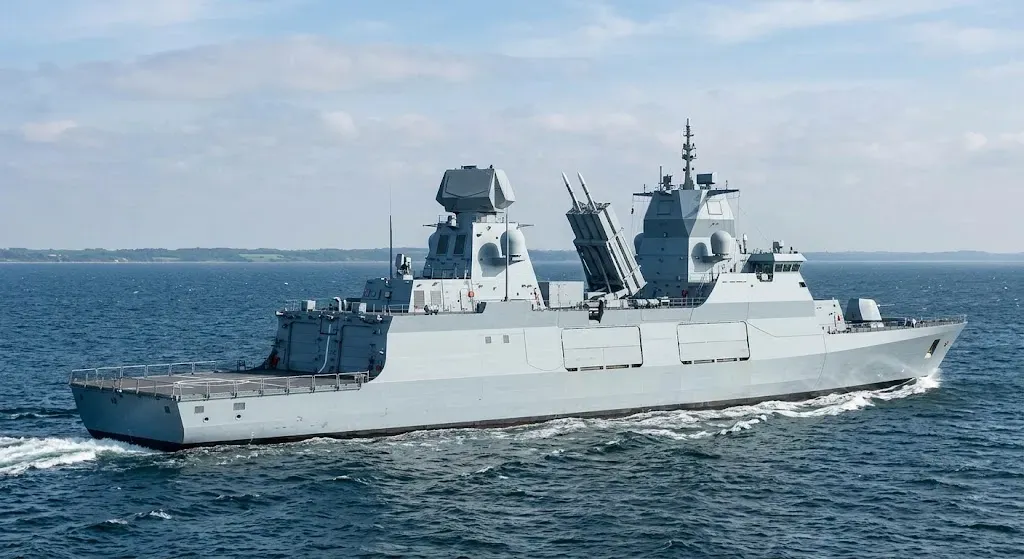
GERMANY —Germany is upgrading the air defense architecture of its naval fleet by integrating advanced ground-based missile systems onto its primary surface combatants. The Federal Office of Bundeswehr Equipment, Information Technology, and In-Service Support has formalized a contract with Diehl Defence to undertake adaptation development for the IRIS-T SLM air defense system, specifically tailored to equip the German Navy's F125 frigates. Under the agreement, the defense manufacturer will build functional prototypes and execute live-fire testing to validate system compatibility and operational readiness on the warship platform.
This contract follows a successful operational trial conducted in late 2025 during maritime exercises, where a modular demonstrator of the system was integrated onto the deck of the F125 frigate Baden-Württemberg. Diehl Defence is an armaments manufacturer headquartered in Überlingen, Germany, specializing in guided missiles, air defense systems, ammunition, and defense electronics for national and international military clients. The Federal Office of Bundeswehr Equipment, Information Technology, and In-Service Support functions as Germany's central military procurement authority, managing the acquisition, development, and maintenance of defense technology for the armed forces.
The initiative addresses critical operational gaps in naval self-defense against modern aerial threats, including unmanned systems, cruise missiles, and low-altitude strike platforms. By adapting proven ground-based air defense technology for maritime deployment, the German military accelerates deployment timelines and reduces developmental risk compared to designing bespoke naval missile systems. This strategy reflects a broader European trend toward cross-domain modularity in defense hardware, enabling armed forces to standardize weapons stockpiles across land and sea domains while enhancing platform survivability in contested littoral environments.
For the defense manufacturing sector and defense contractors, the integration agreement signals sustained investment in secondary weapons fit-outs for existing naval platforms. The successful navalization of land-based systems creates new export opportunities for defense contractors seeking to offer flexible, cost-effective air defense upgrades to allied navies facing evolving security requirements.