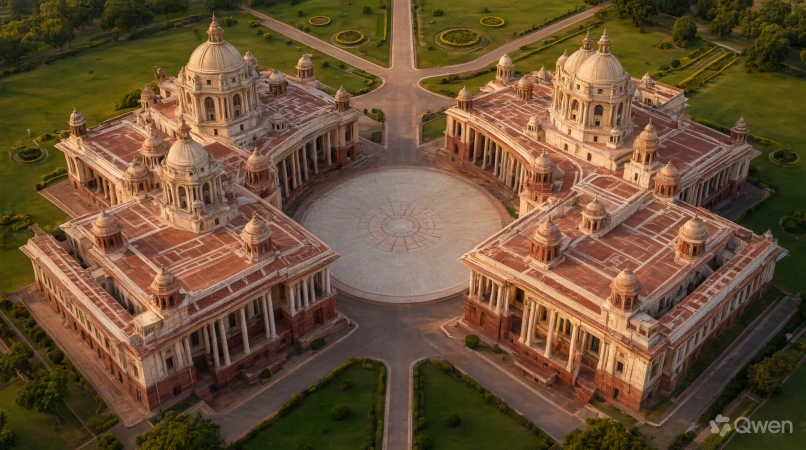
INDIA —The Cabinet Committee on Economic Affairs (CCEA), the apex executive body of the Government of India responsible for reviewing economic trends and approving major public expenditure proposals, has sanctioned an investment of INR 32.3 billion for the development of the Yuge Yugeen Bharat Museum in New Delhi. Cleared during a session chaired by Prime Minister Narendra Modi on November 11, 2026, following an appraisal by the Public Investment Board in July 2026 and concurrence from the Ministry of Culture, the initiative will transform the historic North and South Block buildings into a flagship cultural institution. Originally constructed between 1912 and 1931 atop Raisina Hill flanking Rashtrapati Bhavan, the administrative structures are being vacated as central government ministries relocate to new facilities.
This capital allocation represents a strategic shift in urban asset monetisation and cultural infrastructure policy, turning restricted colonial-era bureaucratic complexes into a high-capacity public destination. Spanning a proposed built-up area of approximately 178,509 square metres, the facility is engineered to accommodate an annual footfall of 10 million visitors, positioning it among the largest display spaces globally. By embedding adaptive reuse into the broader Central Vista redevelopment, the state aims to preserve architectural heritage while establishing a self-sustaining cultural hub capable of generating recurring non-tax revenue through ticketing, venue leasing, retail, and food and beverage concessions.
Implementation will unfold across a five-year horizon from FY 2026-27 through FY 2030-31, creating a substantial pipeline of public-private partnership and vendor procurement opportunities. The scope of work encompasses structural retrofitting, specialized heritage conservation, climate-controlled collection storage, intelligent building management systems, and large-scale landscaping. While the initial public opening—a dedicated gallery examining adornment in the North Block—is scheduled for late 2027, the subsequent phases will demand sustained capital deployment across civil engineering, acoustic design, and advanced security infrastructure.
For private sector enterprises and institutional investors, the project signals robust demand across multiple allied verticals in the National Capital Region. Technology integrators specializing in immersive audio-visual installations, augmented reality, and digital archiving stand to benefit from the mandate to modernize visitor interpretation. Simultaneously, hospitality operators, retail brands, and facilities management firms will find long-term commercial prospects in managing ancillary visitor amenities designed for ten million annual guests, alongside secondary economic spillovers for Delhi's broader tourism and urban transit ecosystems.