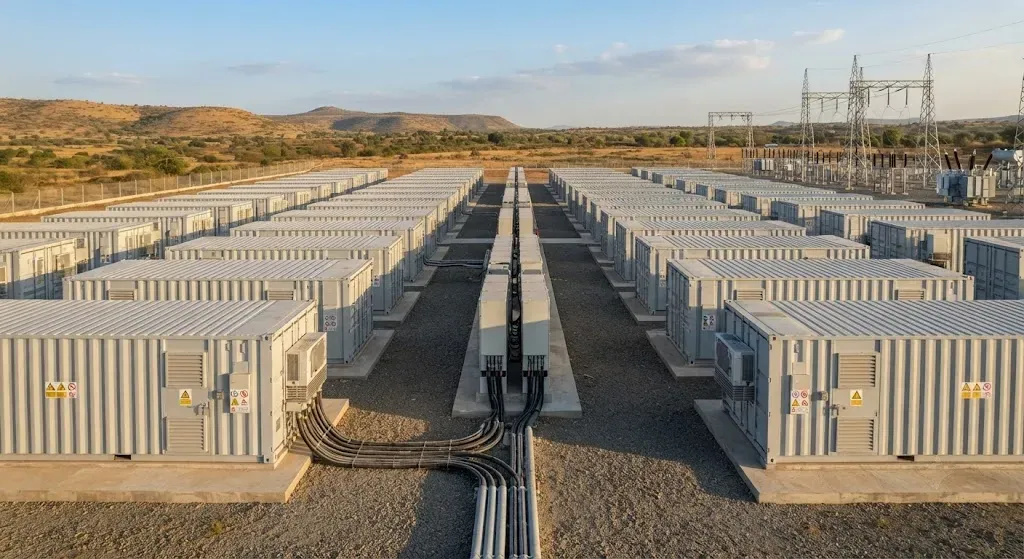
AUSTRALIA —Utility-scale grid storage in the Asia-Pacific region has reached a major operational milestone with the full commissioning of Australia’s most powerful battery asset. According to official corporate disclosures, Hitachi Energy has marked the completion of final commercial operations at the Waratah Super Battery in New South Wales (NSW). Designed to deliver 850 megawatts (MW) of power and store 1,680 megawatt-hours (MWh) of energy, the landmark facility was commissioned and overseen by EnergyCo and the NSW Government, while being built, owned, and operated by battery storage developer Akaysha Energy.
Headquartered in Switzerland, Hitachi Energy operates as the electrification arm of the Hitachi Group, employing over 56,000 personnel across 60 countries and generating approximately $20 billion in annual revenue. For the Waratah deployment, the company supplied, installed, and commissioned 288 power conversion systems (PCS) alongside two central power plant controllers (PPC). Together, these components establish the digital control architecture and fast-response engine that orchestrates the battery's real-time grid interactions. Furthermore, Hitachi Energy is delivering continuous performance visibility, real-time diagnostics, and predictive analytics through its AI-powered HMAX Energy suite under a 20-year long-term service agreement.
The facility’s primary technical mandate is to function as a high-speed digital shock absorber for the state’s electricity network. The battery is wired directly into the control room of Transmission Network Service Provider Transgrid via the System Integrity Protection Scheme (SIPS), the largest monitoring and control system of its kind in Australia. When severe weather events or unplanned generation outages cause network disturbances, the SIPS architecture and Hitachi Energy’s smart controllers detect anomalies within milliseconds, immediately triggering battery dispatch to maintain transmission system strength and prevent cascading blackouts.
From an energy policy and grid planning perspective, the operationalization of the Waratah Super Battery forms a cornerstone of the NSW Government’s Electricity Infrastructure Roadmap. Beyond emergency contingency response, the system captures excess renewable generation during off-peak windows and discharges power during peak demand intervals. Deploying high-capacity storage as a virtual transmission asset provides essential grid inertia and reliability as legacy coal-fired power stations are progressively decommissioned and higher volumes of intermittent wind and solar energy enter the network.
For power utilities, transmission system operators, and institutional infrastructure investors, the project establishes a commercial and technical benchmark for utility-scale battery energy storage systems (BESS) operating as core transmission infrastructure. Integrating high-speed power electronics with multi-decade AI-driven predictive maintenance frameworks de-risks long-term asset performance, accelerating procurement pipelines for grid-stabilizing storage installations across rapidly decarbonizing power markets.