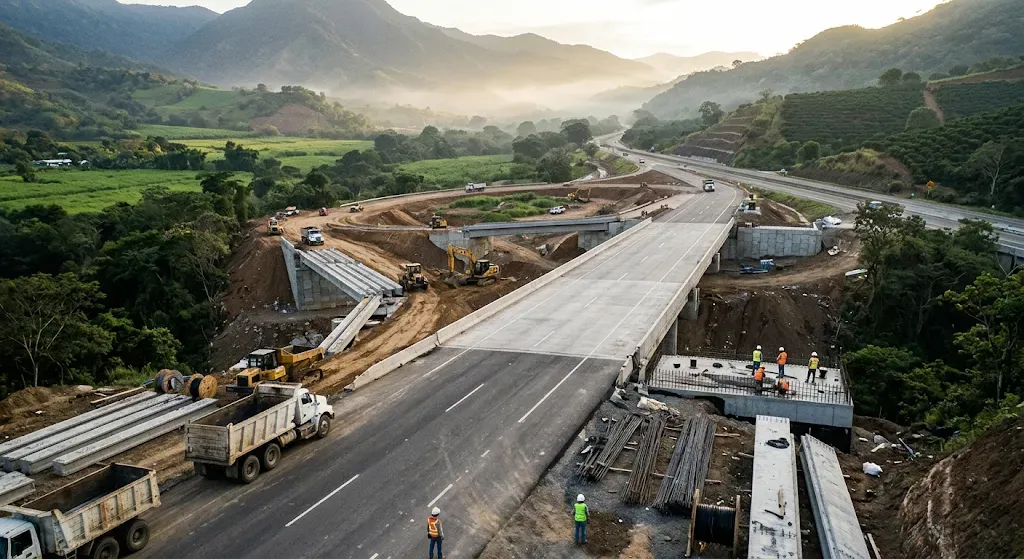
HONDURAS —Financial backing totaling 101.68 million dollars has been authorized by the board of executive directors at the Inter-American Development Bank (IDB) to overhaul regional transit corridors in northwestern Honduras. This capital infusion is designated to reconstruct, upgrade, and sustain 48 kilometers along the Pito Solo to Santa Bárbara segment of National Route 20, alongside local agricultural pathways designed to streamline connectivity. By improving these transit links, the initiative seeks to establish efficient channels connecting regional farming production zones directly with primary logistics pathways and the commercial maritime hub of Puerto Cortés.
This capital allocation represents a strategic intervention under the broader regional integration initiative known as América en el Centro, which targets infrastructure cohesion across Central American economies. Funding for the operation is split into two primary financing streams: approximately 61.008 million dollars originates from ordinary capital resources carrying a 20.5-year repayment schedule with a nine-year grace period linked to SOFR rates, while the remaining 40.762 million dollars stems from concessional ordinary capital resources featuring a 40-year maturity framework and a fixed nominal interest rate of 0.25 percent. Beyond physical pavement repairs and network expansions, a portion of the capital is earmarked for institutional capacity-building initiatives within the local ministry responsible for transport infrastructure, intending to bolster long-term planning, operational prioritization, and sustained asset management.
Stakeholders impacted by these infrastructural upgrades span regional agricultural producers, freight transporters, and commercial enterprises dependent on reliable supply chain movements. Upgraded road conditions are projected to directly benefit tens of thousands of individuals working within local value chains, while thousands more residing immediately adjacent to the construction zones will experience indirect socioeconomic advantages. The modernization directly addresses persistent logistical bottlenecks that historically inflated transportation outlays for rural exporters attempting to reach international shipping ports.
For corporate entities, logistics operators, and project developers, the funding structure provides predictable execution timelines and underscores heightened regional focus on public-private logistics efficiency. Market participants evaluating public sector infrastructure projects in the region gain improved clarity regarding institutional partnership standards and long-term procurement frameworks supported by multilateral lending institutions. Enhanced roadway predictability diminishes freight depreciation and transit times, ultimately improving profit margins for export-oriented agricultural companies operating in the northwestern territories.