
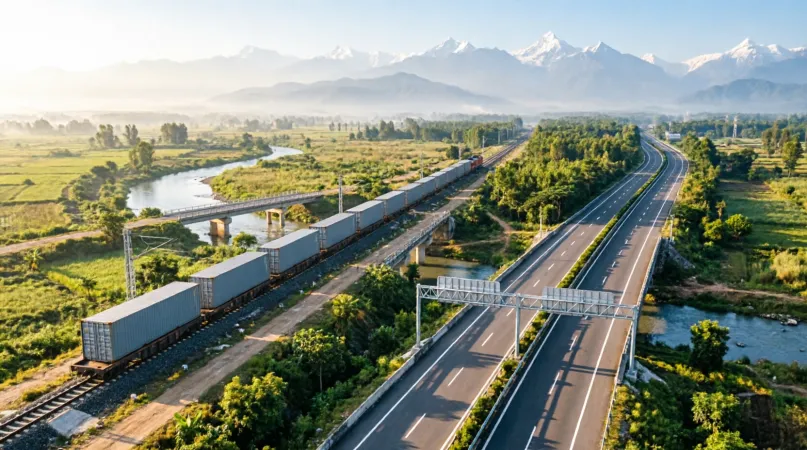
India's Cabinet has approved five major transport infrastructure projects valued at INR 130.41 billion to expand eastern rail corridors and construct a strategic highway to the Nepal border, aimed at cutting logistics costs and increasing cargo capacities.
The Indian government has sanctioned a massive infrastructure investment totaling INR 130.41 billion to address severe capacity constraints across critical transportation corridors. The multi-modal initiative encompasses four rail capacity expansion projects worth INR 94.50 billion and a brownfield highway project costing INR 35.91 billion. The Union Cabinet, India's supreme executive decision-making body chaired by the Prime Minister, oversees major national policy decisions and large-scale public capital allocations to drive economic growth.
This developmental push focuses primarily on quadrupling critical segments along the Howrah-Chennai High Density Network route. Approved rail undertakings include adding a fourth track on the 173-kilometer Kharagpur-Bhadrak stretch for INR 33.52 billion, a fourth track on the 75-kilometer Bhadrak-Haridaspur section for INR 15.83 billion, and expanding the 90-kilometer Gummidipundi-Gudur line to four tracks for INR 22.29 billion. Additionally, a third and fourth line will be constructed on the 72-kilometer Cuttack-Paradeep rail line for INR 22.86 billion to serve port traffic. Complementing the rail investment, the government cleared an 83-kilometer four-lane highway corridor from Muzaffarpur to Sonbarsa via Sitamarhi in Bihar to strengthen cross-border trade infrastructure near Nepal.
These infrastructure upgrades directly target India's high logistics overheads by optimizing heavy freight movement across key industrial hubs. The quadrupling of lines along the eastern coast will ease severe network congestion, where utilization on some segments currently exceeds 130%. By creating dedicated tracks for freight, the rail projects will add over 75 million tonnes in annual freight capacity, linking key steel clusters and coal fields in Odisha and Jharkhand directly to eastern ports like Dhamra, Paradip, and Syama Prasad Mookerjee Port. Meanwhile, the Bihar road corridor reduces transit times by half, facilitating smoother bilateral trade with Nepal.
For investors, logistics operators, and industrial enterprises, the expansion promises significant supply chain efficiencies and lower operational costs. Rail-sea-rail movement for bulk commodities such as coal and iron ore will become significantly more reliable, benefiting domestic power generation plants and manufacturing facilities in southern and eastern India. Engineering, procurement, and construction (EPC) contractors stand to gain substantial procurement opportunities over the project implementation timelines, which range from 30 months for the highway to four years for the railway lines.
About GlobeNewsInfo
GlobeNewsInfo.com is a business news platform providing latest updates on global business developments, projects, and contract opportunities across diverse sectors and regions. The platform is designed to serve as a trusted source of information for companies, investors, and professionals worldwide.