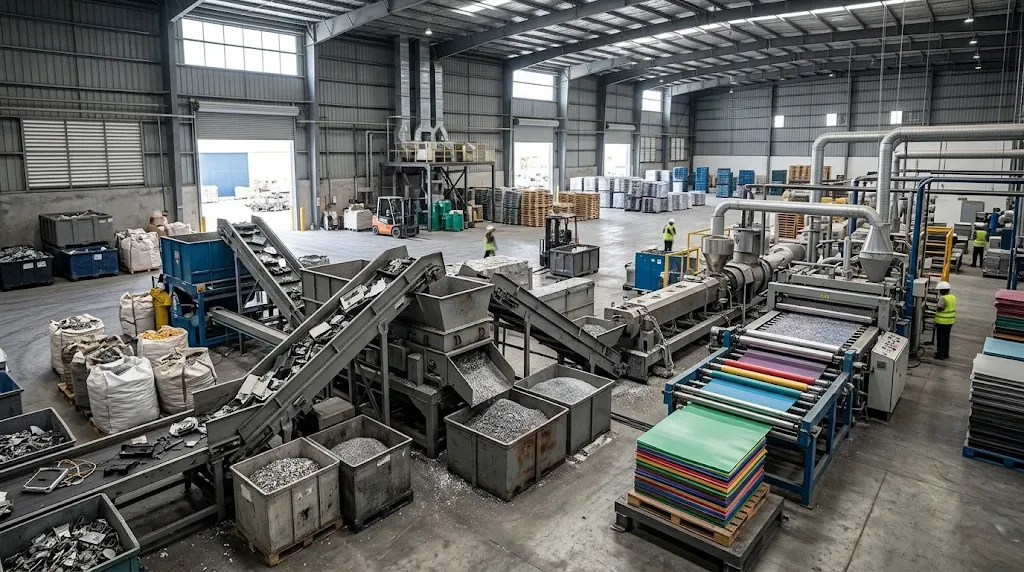
UNITED ARAB EMIRATES —Mumbai-based manufacturer Kshitij Polyline is committing AED 25 million to establish a new plastic and plastic e-waste recycling facility in the United Arab Emirates (UAE). Funded through a blend of equity and bank financing, the plant will use sorting, shredding, and processing equipment to turn discarded plastics and electronic plastic scrap into recycled raw materials and plastic sheets geared toward stationery production. Kshitij Polyline manufactures plastic sheets, films, profiles, and stationery items such as files, folders, binding materials, and lamination products from polymers including polypropylene and polyvinyl chloride, with operations based in India.
This move represents a cross-border step into Gulf recycling infrastructure that links waste feedstock recovery directly to polymer sheet manufacturing. By processing both general plastic waste and plastic e-waste locally, the facility targets lower carbon emissions and reduced landfill volumes while creating an internal or regional supply of secondary resin and sheets.
Within the UAE, the investment intersects with federal and emirate-level waste diversion priorities, including the UAE Net Zero 2050 strategy and the Dubai Integrated Waste Management Strategy 2041. Beyond stationery manufacturing, recovered materials from the site are intended to serve broader industrial demand across construction, packaging, and general manufacturing, while relying on collection and segregation links with municipalities, businesses, and local communities.
For commercial decision-makers and investors, the project signals growing corporate interest in closed-loop polymer supply chains across the Gulf, where regulatory momentum favors higher recycling rates and domestic secondary materials. At the same time, key commercial variables-including annual processing capacity, construction timelines, target polymer grades, and whether output is bound for captive stationery use or third-party sales-have not been disclosed, making execution discipline, feedstock sourcing costs, and capital structure central to evaluating long-term returns.