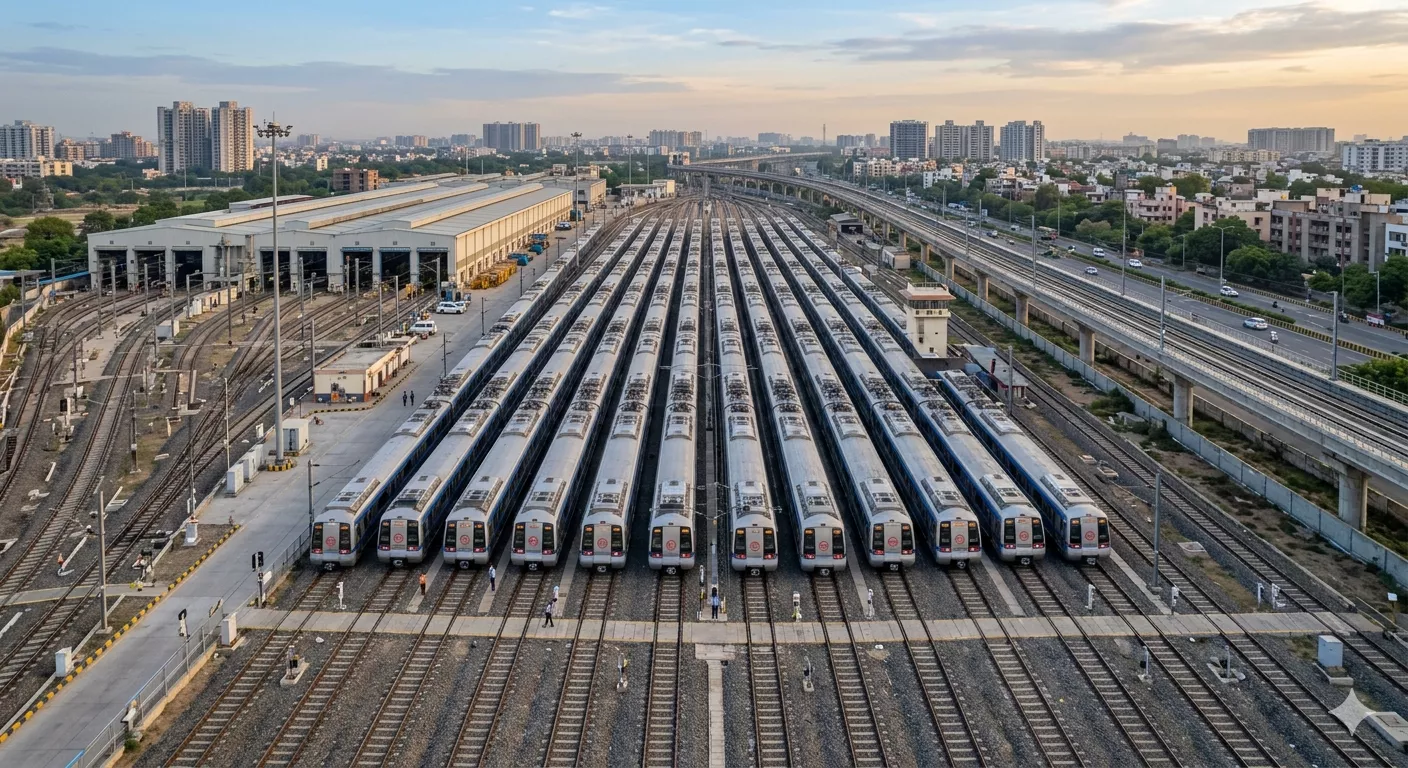
INDIA —The Ministry of Railways has sanctioned a 1.25 billion rupees capital expenditure project to modernize and expand the Bhavnagar Para railway yard in Gujarat, India. The comprehensive engineering scheme includes track layout reconfiguration, signaling and electrical infrastructure upgrades, new service facilities, and civil works for two road under bridges, comprising the construction of one new underpass alongside the extension of an existing structure. These modifications are structured to expand operational handling capacity and alleviate persistent congestion at the adjacent Bhavnagar Terminus station. Indian Railways is the state-owned statutory body under the Ministry of Railways that operates India's national rail network, representing one of the largest rail systems globally. The Ministry of Railways serves as the executive government body responsible for administrative oversight, policy formulation, and capital allocation across the national railway network.
Bhavnagar serves as a critical commercial, industrial, and maritime hub in the Saurashtra region of western India, where expanding economic activity has placed severe pressure on existing passenger and logistics infrastructure. The current operational bottleneck at Bhavnagar Terminus restricts train turnaround times, limits track availability, and creates scheduling delays across regional transit corridors. By shifting operational load and technical switching functions to an expanded Bhavnagar Para yard, the project provides enhanced operational flexibility for passenger lines while improving urban mobility through grade-separated road underpasses that eliminate level-crossing delays.
This approval highlights the ongoing national strategy by the Indian government to modernize regional rail nodes and eliminate logistics bottlenecks under broader public infrastructure frameworks. Upgrading yard infrastructure and replacing legacy signaling equipment directly impacts the transportation and civil engineering sectors by generating localized construction contracts and establishing higher-capacity corridors for intercity movement. Furthermore, integrating grade-separated road crossings aligns with policy efforts to enhance urban road safety, reduce localized vehicular congestion, and decrease travel friction near heavy rail operations.
For regional commerce, industrial freight forwarders, and trade operators around Gujarat's coastal industrial belt, improved rail efficiency offers reduced transit times and greater reliability for goods movement. Enhancing terminal capacity positions the Bhavnagar rail network to accommodate higher traffic volumes, supporting ongoing expansion in regional manufacturing, agriculture, and maritime trade. Engineering firms and equipment suppliers in signaling, electrification, and civil infrastructure also stand to benefit as project execution progresses through public procurement channels.