AUSTRALIA —Institutional backing for sustainable public transit infrastructure has strengthened following a A$660 million capital raise aimed at expanding global mass transit operations. Managed by real assets investment firm Foresight Group, the oversubscribed continuation structure allows existing and new institutional funders, including domestic superannuation schemes and international investment funds, to maintain equity exposure in global operator Kinetic. Under the revised arrangement, Foresight maintains a 30 percent equity stake alongside joint investor TPG Rise Climate, preserving the current ownership distribution while injecting capital for regional and international fleet growth.
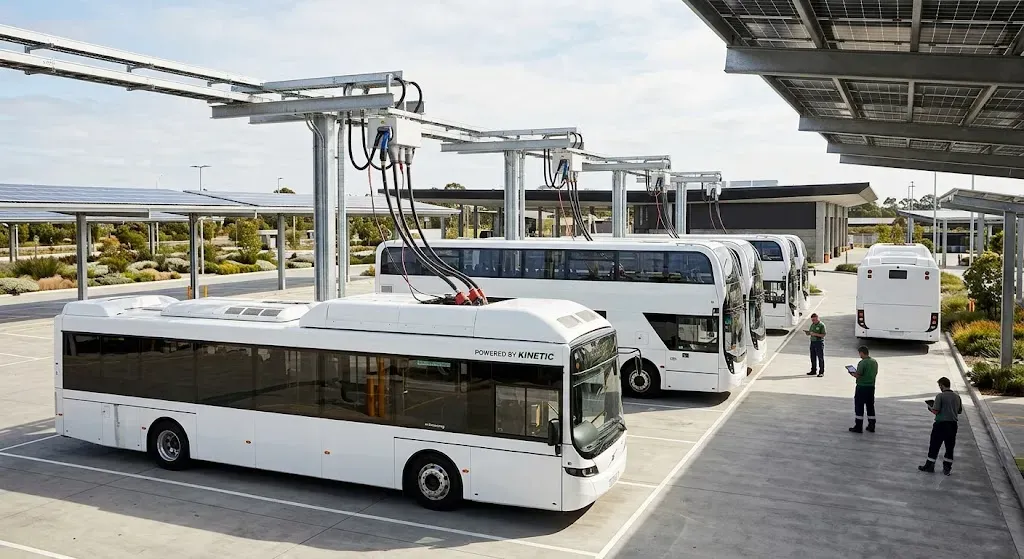
Headquartered in London, Foresight Group is an infrastructure and private equity manager with roughly A$5 billion in Australian assets under management, focusing on real asset strategies, energy transition assets, and essential service infrastructure. Kinetic operates as a multi-modal public transit network managing over 300 contracts across Australia, New Zealand, the United Kingdom, Europe, and Asia. The business maintains a operational fleet exceeding 12,000 buses and 470 rail cars, incorporating over 1,900 battery-electric buses across 33 specialized zero-emission depots.
This capital deployment emphasizes growing institutional demand for essential transportation assets that deliver contractually protected revenue streams alongside decarbonization targets. Public transit networks face mounting pressure from municipal governments to phase out internal combustion engines in favor of zero-emission fleets. The influx of dedicated funding directly addresses the heavy upfront capital requirements required to convert bus fleets, upgrade depot charging infrastructure, and scale cross-border operational capacity.
The funding transaction provides financial runway for Kinetic to fulfill recently secured transit franchises, including urban bus contracts in Victoria and Singapore, as well as rail transportation commitments in London and Stockholm. For institutional investors, continuation vehicles offer a mechanism to retain high-performing infrastructure platforms without triggering asset liquidation, enabling long-term capital to support multi-year fleet transition programs and regional network integrations.