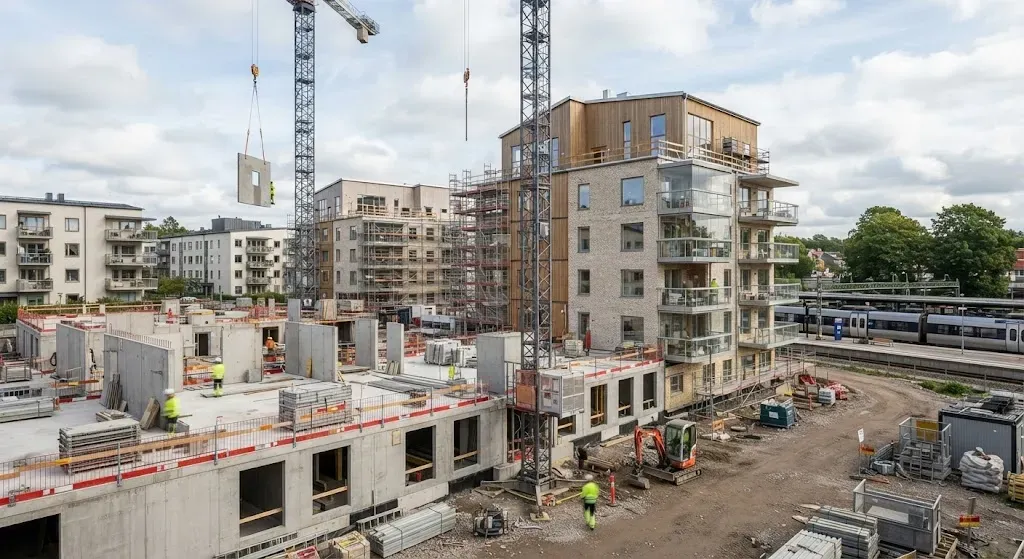
SWEDEN —Nordic residential developer JM has officially commenced construction on Ture Gård, a 100-unit tenant-owned housing development located in the Tureberg district of Sollentuna, Sweden. The project represents the third and final development phase of the broader Ture block master plan. Once completed alongside the project’s prior phases-Ture Torn and Ture Entré, constructed by JM subsidiaries AB Borätt and Seniorgården AB respectively-the entire block will deliver 221 modern residential units to the local market. Commercial sales for the individual units are active, with project completion and initial resident move-ins scheduled for the third quarter of 2027.
JM is a prominent developer of residential property and community master plans across the Nordic region, focusing on metropolitan growth hubs in Sweden, Norway, and Finland. Headquartered in Sweden, the publicly traded entity generates approximately SEK 11 billion in annual sales and employs roughly 1,900 professionals.
The commencement of Ture Gård underscores ongoing institutional investment in high-density, transit-oriented housing developments within Sweden’s urban centers. Situated adjacent to the former Sollentuna Fair site, the development benefits from direct connectivity to the local commuter rail network and commercial amenities at Sollentuna Centrum. This proximity aligns with municipal urban redevelopment frameworks aimed at revitalizing suburban sub-markets surrounding Stockholm. High-density residential projects positioned near transport hubs continue to attract sustained demand from prospective homebuyers seeking urban accessibility combined with community infrastructure.
From a market standpoint, the execution of multi-phase developments allows housing operators to optimize capital allocation and scale delivery according to local demand absorption. By completing the final phase of the Ture block within a condensed timeline, JM mitigates long-term construction exposure while delivering turnkey inventory to the Greater Stockholm housing market. The successful rollout of residential capacity in key infrastructure corridors remains a critical benchmark for regional macroeconomic growth, institutional property values, and supply-demand stabilization across Swedish real estate markets.