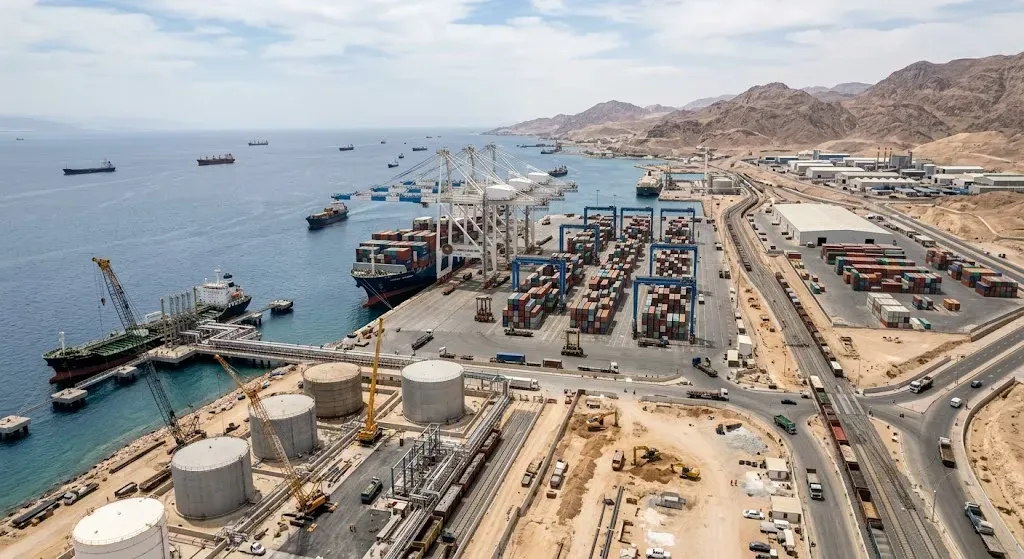
JORDAN —Jordan is prioritising upgrades to Aqaba’s maritime and logistics infrastructure as the government seeks to expand regional freight capacity, improve energy security and strengthen the country’s role in cross-border trade. Prime Minister Jafar Hassan reviewed operations across the Aqaba port system and called for faster implementation of development projects during a meeting at the Aqaba Company for the Management and Operation of Ports.
A central component of the programme is the expansion of the Aqaba Oil Port, including measures to increase its handling capacity. The government expects these works to be completed within the next two years. Additional capacity is intended to reinforce petroleum distribution to neighbouring countries and improve the resilience of regional energy supply chains, although specific investment values and capacity targets have not been disclosed.
The port development programme is being coordinated with wider transport infrastructure initiatives. Jordan recently marked the start of the Aqaba-Al-Shidiya-Ma’an Railway Project, which is intended to improve freight connectivity between the coastal gateway and inland industrial and economic centres. The government has also identified the Aqaba-Ma’an Inland Port Project as a strategic priority to improve cargo transfers, storage operations and transit trade. Together, these initiatives aim to integrate maritime terminals with inland freight networks and improve the movement of goods.
Administrative reforms have focused on accelerating cargo handling and customs clearance, facilitating import and export procedures, expanding storage-yard capacity and supporting strategic inventories. These measures are intended to reduce logistical bottlenecks and improve supply chain continuity amid regional disruption and uncertainty.
Industrial competitiveness is another element of the strategy. A natural gas supply project serving industrial clusters in Aqaba and Al-Quwayrah, inaugurated approximately three months before the announcement, is expected to lower energy costs for domestic manufacturers and support export-oriented production. Improved access to gas, combined with stronger port and inland freight infrastructure, could benefit energy-intensive industries and businesses dependent on imported raw materials or regional distribution networks.
For shipping operators, freight forwarders, importers and exporters, the commercial impact will depend on project delivery, operating efficiency and integration between port, rail and inland storage facilities. Petroleum distributors and industrial manufacturers could also benefit from improved supply reliability and lower logistics or energy costs. However, project budgets, quantified capacity increases and detailed commissioning milestones have not been disclosed, limiting assessment of the immediate financial implications.
The government has also emphasised compliance with high safety and security standards across the ports. Successful implementation of the Aqaba–Ma’an Inland Port Project and related infrastructure initiatives could strengthen Jordan’s regional logistics position, support transit trade and improve the competitiveness of domestic export sectors.