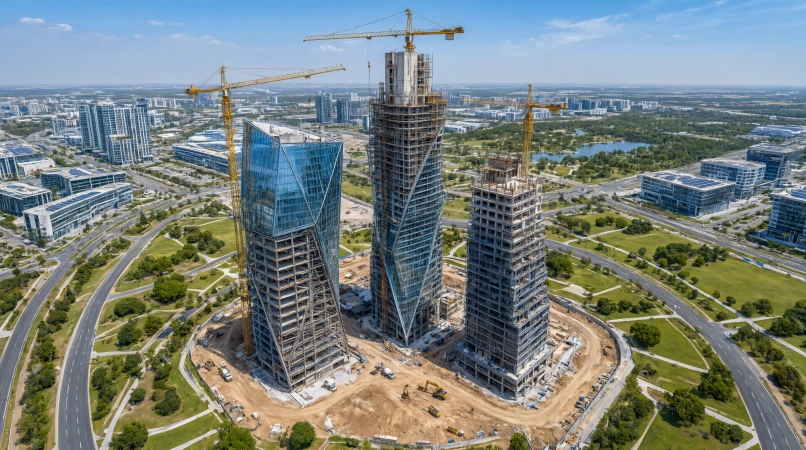
KAZAKHSTAN —A major commercial development has commenced in Kazakhstan's newly planned urban zone, signaling progress in the country's strategy to establish a regional financial and logistics hub. The project, named Iconic Complex, represents an investment of over $800 million and will feature two high-rise towers standing at 272 meters and 78 meters. Designed by United States-based architectural practice Skidmore, Owings & Merrill and constructed by general contractor China State Construction Engineering Corporation, the multifunctional facility will accommodate office space, residential units, a hotel, and retail operations, with target completion set for late 2029.
China State Construction Engineering Corporation is a state-owned enterprise headquartered in Beijing specializing in global infrastructure and building development. Skidmore, Owings & Merrill is an American architecture, urban planning, and engineering firm known for designing supertall skyscrapers and large-scale urban master plans.
The investment underscores Kazakhstan's ambition to create a dedicated economic center positioned strategically between Almaty and Konayev. Located along critical transit corridors linking China, Central Asia, Europe, and the Middle East, the site is being built to attract cross-border capital, boost local employment, and diversify the national economy away from traditional commercial centers. Capital inflow into the municipality's fixed assets reached 70.3 billion tenge ($133 million) in the first nine months of 2026, forming part of a broader $6.9 billion investment pipeline encompassing 67 individual development projects.
To support large-scale real estate and municipal infrastructure works, local public administration has established a special legal and regulatory framework incorporating independent technical reviews by international technical experts. Concurrently, government-funded infrastructure initiatives totaling 35.3 billion tenge ($78.2 million) are underway to deliver municipal utility services, water supply network upgrades, power grid reconstruction, and road connectivity required for high-density commercial developments.
For international investors, contractors, and real estate developers, the project highlights expanding commercial opportunities within Central Asian urban infrastructure. The long-term urban roadmap, extending through 2055 in collaboration with global consulting groups, provides a framework for persistent infrastructure development, engineering procurements, and commercial real estate investments in regional trade and transit hubs.