KENYA —Agribusinesses, financial service providers, and livestock input suppliers operating in East Africa face a structured expansion of their rural customer base following the operationalization of the Climate Action for Sustainable Agriculture and Livelihoods (CASHA) initiative in Kenya. On November 18, 2026, key implementing partners convened in Wote to finalize participant onboarding frameworks for the five-year program, which will formalize 26,000 youth-led livestock enterprises in Makueni County alone, alongside coordinated rollouts in Kitui, Kajiado, and Taita Taveta counties.
The operational alignment was spearheaded by the Makueni County Department of Agriculture, Livestock, Fisheries and Cooperative Development in collaboration with the Food and Agriculture Organization (FAO). The Food and Agriculture Organization (FAO) is a specialized agency of the United Nations that leads international efforts to defeat hunger and improve nutrition and food security globally. Makueni County Government is a devolved sub-national administration in Kenya’s lower eastern region, led by Governor Mutula Kilonzo Jr., responsible for local agricultural extension, economic development, and public service delivery.
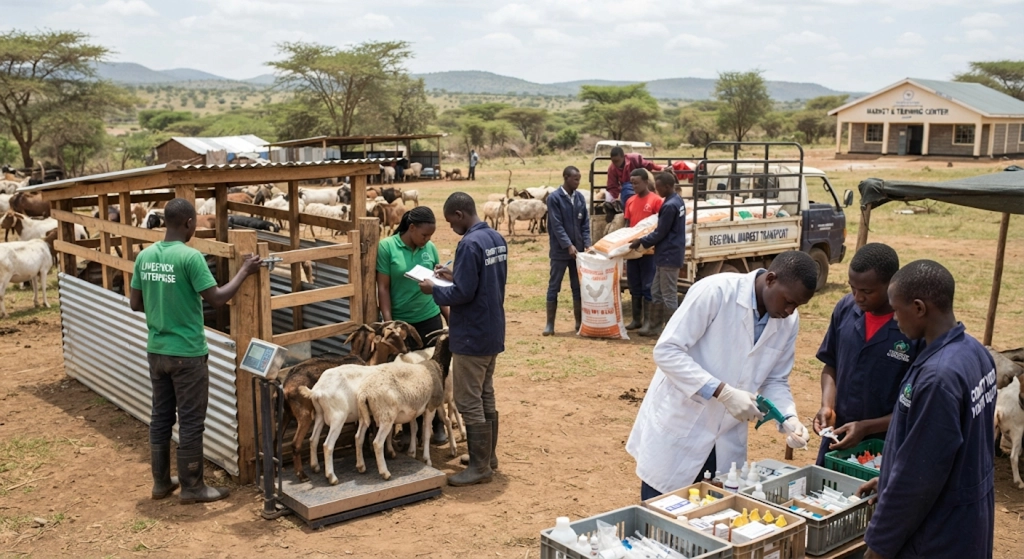
Rather than treating livestock rearing as a subsistence activity, the program restructures the regional value chain by linking newly trained producers directly to commercial off-takers and formal supply networks. According to County Executive Committee Member Japheth Mang’oka, the initiative prioritizes equipping participants with technical capabilities, productive assets, and established market pathways to ensure commercial viability. Notably, the demographic allocation mandates that 80% of the 26,000 targeted beneficiaries in Makueni be young women, while 5% are reserved for persons with disabilities, creating a concentrated, organized cohort of emerging small-scale commercial operators.
To execute this multi-county rollout, the public sector has assembled a specialized delivery network comprising BOMA’s Lower Eastern regional unit, Anglican Development Service Eastern (ADSE), the Kenya Livestock Marketing Council (KLMC), and the Candles of Hope Foundation. The Kenya Livestock Marketing Council is an umbrella industry body representing livestock producers and traders across Kenya’s arid and semi-arid lands, working to improve market access and commercialization. Master trainers and focal persons from all four participating counties are harmonizing curricula to standardize production quality across the lower eastern and coastal corridors.
For regional policymakers and industry stakeholders, this coordinated onboarding signals a shift toward institutionalized, climate-resilient pastoral and semi-arid farming models. By embedding technical training with market linkage mechanisms across four contiguous counties, the policy framework reduces fragmentation in Kenya’s domestic meat, dairy, and hides supply chains. Standardizing husbandry practices across tens of thousands of new entrants will also streamline compliance with national animal health regulations and enhance regional traceability.
For commercial enterprises and investors, the five-year rollout presents immediate downstream opportunities across the agricultural value chain. The formalization of 26,000 new production units in Makueni-and thousands more across neighboring counties-will drive sustained demand for animal feed, veterinary pharmaceuticals, breeding stock, and climate-smart water harvesting technologies. Furthermore, financial institutions, micro-lenders, and agritech platforms can leverage the structured onboarding data and institutional backing of FAO and KLMC to de-risk credit underwriting, deploy mobile payment ecosystems, and establish bulk off-take agreements in previously underserved rural markets.