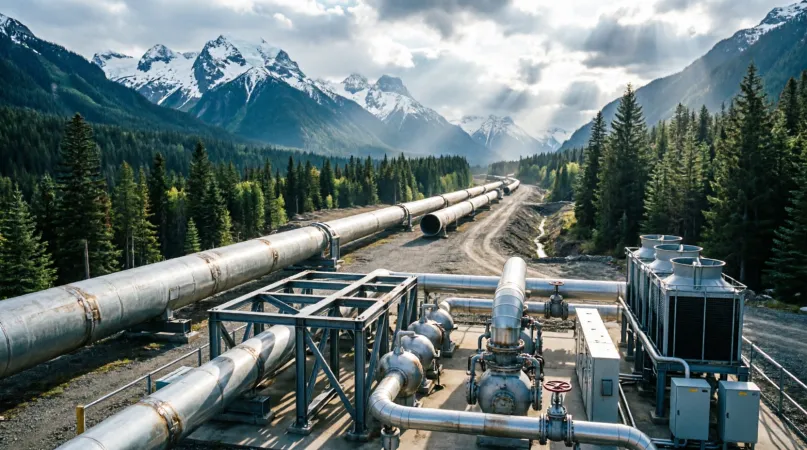
CANADA —Enbridge has secured a strategic funding partnership with private equity firms KKR and Apollo to advance the expansion of its Westcoast natural gas pipeline network in British Columbia. Under the agreement, KKR and Apollo will inject approximately C$2.7 billion into the project, transferring C$700 million in upfront cash to Enbridge upon closing. In exchange, the investor group will acquire a cumulative 29% indirect equity interest in the overall Westcoast system once the second phase becomes operational. Enbridge retains majority ownership and full operational command of the infrastructure while holding an option to repurchase the equity stake between seven and fourteen years after completion.
The joint capital arrangement specifically targets the Aspen Point and Sunrise Expansion Programs, which are designed to increase the pipeline's daily transport capacity from 3.6 billion cubic feet to 3.9 billion cubic feet. Commercial operations for Aspen Point are scheduled to begin in 2026, followed by the Sunrise phase in late 2028. Both projects have received regulatory approval and are backed by long-term take-or-pay agreements, securing revenue stability. Headquartered in Calgary, Enbridge operates one of North America's largest energy transport networks, encompassing natural gas pipelines, crude oil systems, and renewable energy assets.
This transaction provides critical financial liquidity for capital-intensive midstream energy assets, enabling operators to optimize capital allocation without stretching balance sheets. By shifting partial asset ownership to institutional investors while maintaining operator control, energy companies can recycle capital into higher-yielding growth projects. The partnership also underscores private equity's sustained interest in hard infrastructure yielding predictable, long-term cash flows backed by strong commercial counterparties.
The expansion significantly enhances energy security and supply capacity across Western Canada, the U.S. Pacific Northwest, and regional export channels. Greater pipeline throughput ensures reliable fuel deliveries to industrial power generation facilities, local distribution utilities, and international liquefied natural gas (LNG) export terminals. Infrastructure bottlenecks in key basin regions are expected to ease, providing downstream energy consumers and market participants with improved supply flexibility through the decade.