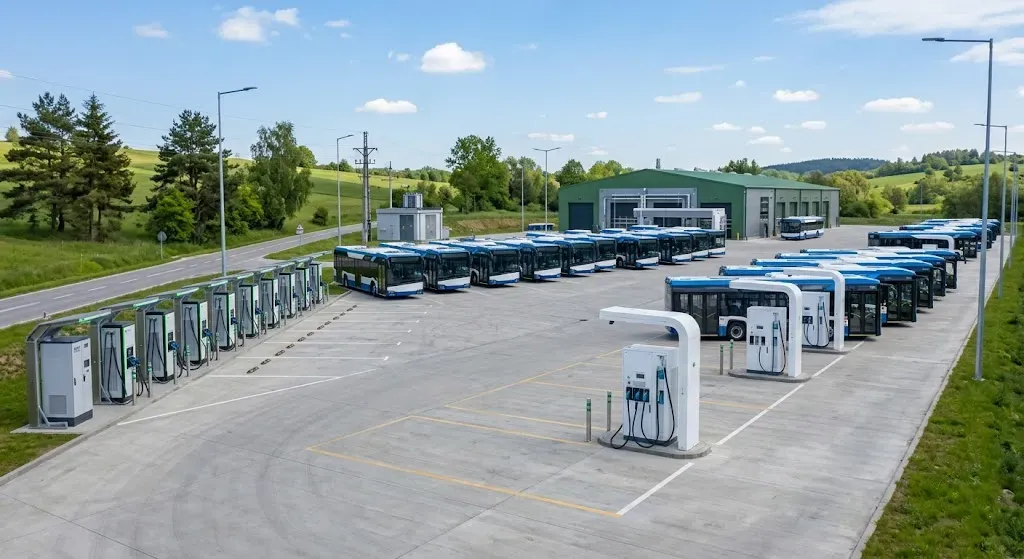
POLAND —Regional public transport connectivity in southeastern Poland has received a significant low-carbon upgrade following the completion of a major EV charging infrastructure deployment in the Małopolska province. System integrator BIBUS MENOS and Finnish charging equipment manufacturer Kempower delivered an 18-point charging network with a total capacity of 1.4 MW for regional transport provider Koleje Małopolskie. Operating across hubs in Kraków, Tarnów, and Proszowice, the dynamic charging setup is built to support a newly acquired fleet of 15 battery-electric and 5 hydrogen fuel-cell buses that serve as feeder connections to the regional rail network.
Koleje Małopolskie is a regional passenger transport company owned by the Małopolska Voivodeship in Poland, operating integrated rail and feeder bus services to improve mobility across local communities. Kempower, a Finnish public company listed on Nasdaq Helsinki, specializes in modular DC fast-charging solutions for electric passenger cars, commercial vehicles, and heavy transit systems. BIBUS MENOS is a Polish-Swiss engineering firm within the international BIBUS Group, delivering industrial automation, mechatronics, and energy infrastructure solutions across Central Europe.
The newly operational charging infrastructure combines distributed charging satellites, central power units, and specialized depot charging systems managed via centralized fleet control software. This setup integrates vehicle preconditioning and automated charging schedules across vehicles supplied by MAN Truck & Bus Polska, Solaris Bus & Coach, and Mercedes-Benz. By implementing dynamic power allocation across geographically constrained sites, the project ensures optimized grid draw while supporting multi-OEM fleet operations across urban and suburban routes.
This deployment highlights the growing shift among European regional transit agencies toward multi-modal zero-emission integration. Beyond urban municipal centers, regional feeder routes present unique operational challenges requiring flexible high-power charging architectures. As European Union decarbonization mandates accelerate, successful implementations combining battery-electric infrastructure with hydrogen fuel-cell fleets offer a scalable blueprint for medium-capacity transit operators across Central and Eastern Europe.