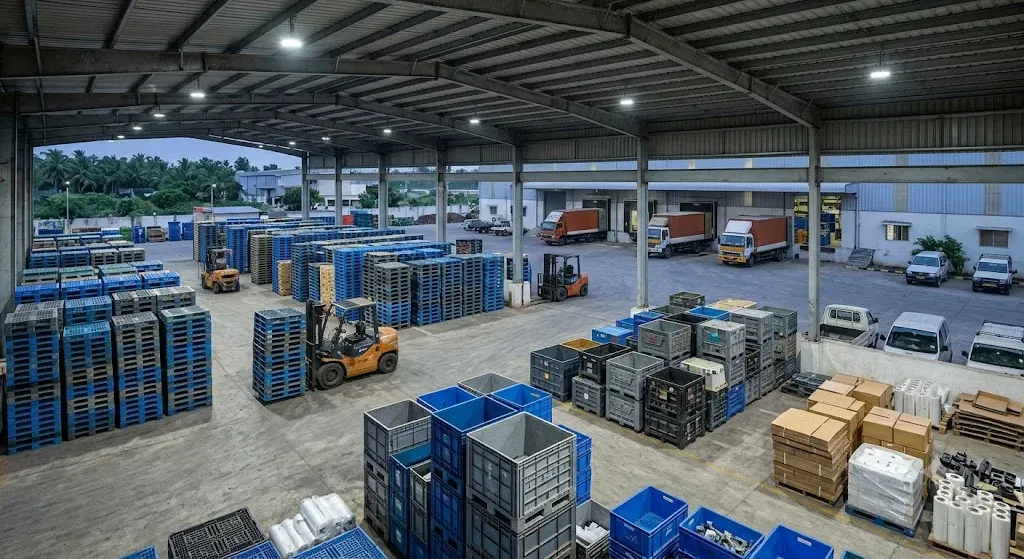
INDIA —LEAP India Limited has executed definitive agreements through its wholly owned subsidiaries to acquire two separate businesses via slump sales on a going concern basis. Vimprotech Private Limited has entered into an agreement with the sole proprietorship Vimprotech to acquire its manufacturing undertakings for a cash consideration of INR 1.02 billion, payable in tranches. Simultaneously, Total Integrated Packaging Solutions Private Limited has signed a business transfer agreement with the partnership firm Total International Packaging Solutions for a cash consideration of INR 400 million. Both transactions are subject to closing conditions and are anticipated to conclude during the third quarter of the fiscal year 2026-27.
Established as a prominent asset-pooling enterprise, LEAP India Limited manages standardized pallets, containers, and material handling equipment across multiple fulfillment centers and customer touchpoints. The corporate entity maintains an extensive operational network serving numerous customers in diverse commercial sectors.
These strategic consolidations allow the corporate group to achieve backward integration by bringing custom plastic packaging production in-house. By integrating proprietary design and manufacturing capabilities, the enterprise expects to decrease external supply dependencies, enhance operational margins, and improve turnaround timelines for packaging assets. Furthermore, absorbing the targeted entities broadens the product catalogue, encompassing specialized trays, covers, flute boards, and pallets tailored for industrial segments.
The structural expansion primarily affects the industrial packaging, manufacturing, and automotive supply chain sectors. Geographically, the acquisition strengthens operational density within southern and central industrial corridors of India, where the target entities maintain their primary manufacturing and pooling assets. Stakeholders including commercial clients, regional suppliers, and logistics operators face altered market dynamics as the corporate entity scales its asset-pooling footprint.
For market investors and enterprise leadership, the dual acquisitions signal a definitive push toward inorganic growth and capital efficiency. Captive production assets enable better cost control amid fluctuating raw material prices, while cross-selling opportunities across an expanded customer base enhance revenue visibility. Market participants will monitor integration milestones and quarterly financial performance to evaluate whether the projected operational efficiencies materialize post-closure.