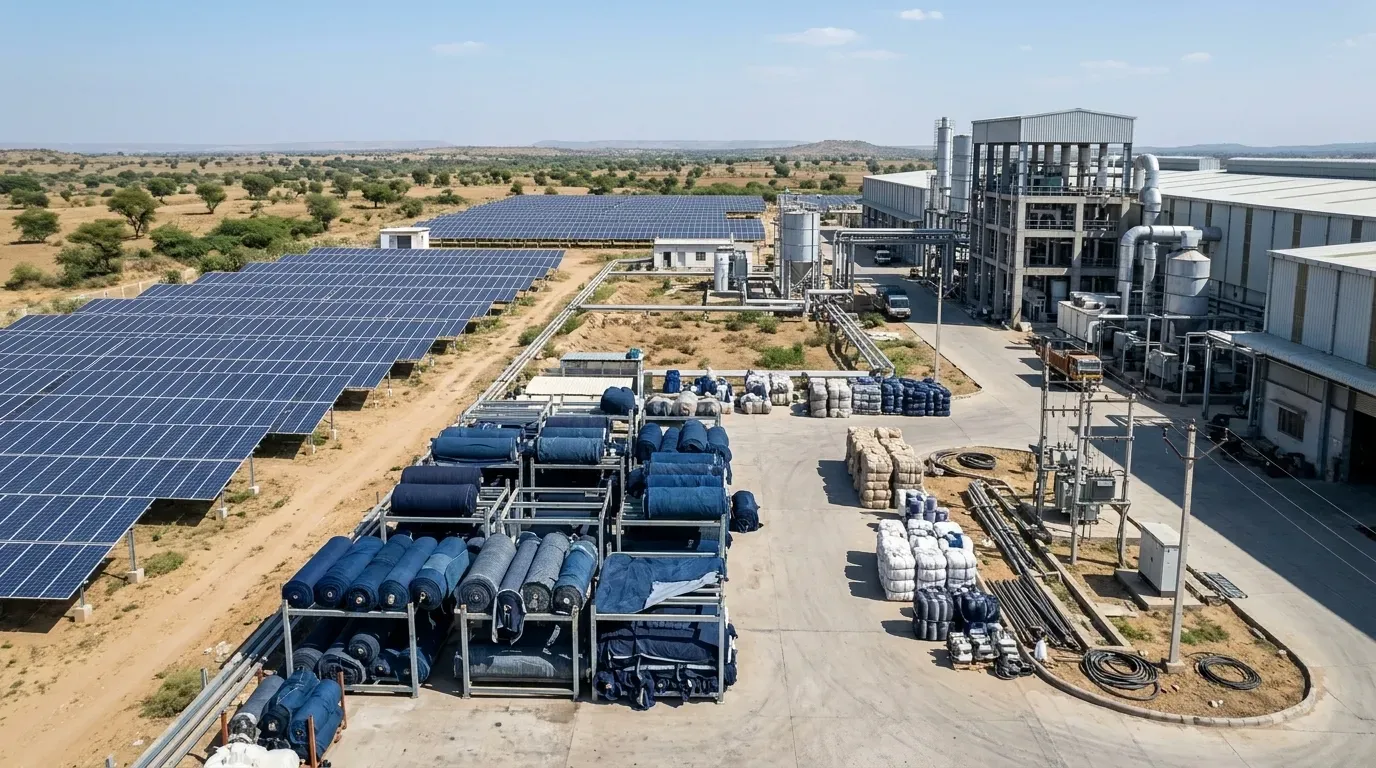
INDIA —Manomay Tex India has earmarked roughly ₹486 million, to develop a solar power facility with capacities of 8.80 MW AC and 13.20 MW DC in Chohtan within Rajasthan's Barmer district. Alongside this clean energy commitment, the manufacturer is advancing capacity additions across its fabric and yarn operations, including equipment orders for a ready-for-dyeing line suited to bottom-weight textiles and chinos, as well as new spindles designed to add roughly 1,080 metric tons of coarse-count yarn output annually. Electricity generated from the solar installation is projected to yield approximately 1,635,000 units per megawatt-peak each year and will feed the company's denim and spinning plants located in the Gangrar tehsil of Chittorgarh district.
Incorporating dedicated solar supply directly addresses energy cost volatility and carbon intensity in energy-intensive textile manufacturing. Spinning, weaving, and wet processing require steady electricity baseloads, making captive or dedicated renewable generation a practical lever to stabilize unit conversion costs over multi-year horizons. Pairing cleaner power generation with downstream ready-for-dyeing capability and upstream coarse yarn expansion also reinforces operational control across key stages of production, supporting supply reliability for both domestic apparel buyers and export customers across more than fifteen overseas markets.
Across India's textile sector, industrial operators increasingly pair green power investments with environmental compliance infrastructure such as zero liquid discharge and effluent treatment systems to meet stricter sustainability expectations from global brands and lenders. Within Rajasthan, a major hub for denim and spinning that combines strong solar irradiation in western districts like Barmer with established textile clusters in Chittorgarh and Bhilwara, intra-state renewable power projects highlight how regional resource endowments can support industrial competitiveness. For textile producers and utility developers alike, aligning capital expenditure with decarbonization and process efficiency is shifting from a niche environmental initiative toward standard operating discipline.
Incorporated in 2009, Manomay Tex India commenced commercial denim fabric production in 2013 in Rajasthan's Chittorgarh district, moved from the BSE SME platform to the mainboards of the BSE and NSE in 2023, and brought an integrated denim and spinning setup into commercial operation in 2024 with a portfolio spanning dobby, knit dobby, three-by-one twill, two-by-one twill, and satin denim. For executives and institutional investors, the dual focus on captive renewable generation and targeted capacity expansion signals an effort to protect margins through lower power expenses and higher value-added output. Key execution variables to monitor include project commissioning timelines, transmission and wheeling arrangements between Barmer and Chittorgarh, utilization rates on new coarse-count spindles and dyeing lines, and realization trends in denim and bottom-weight fabrics.