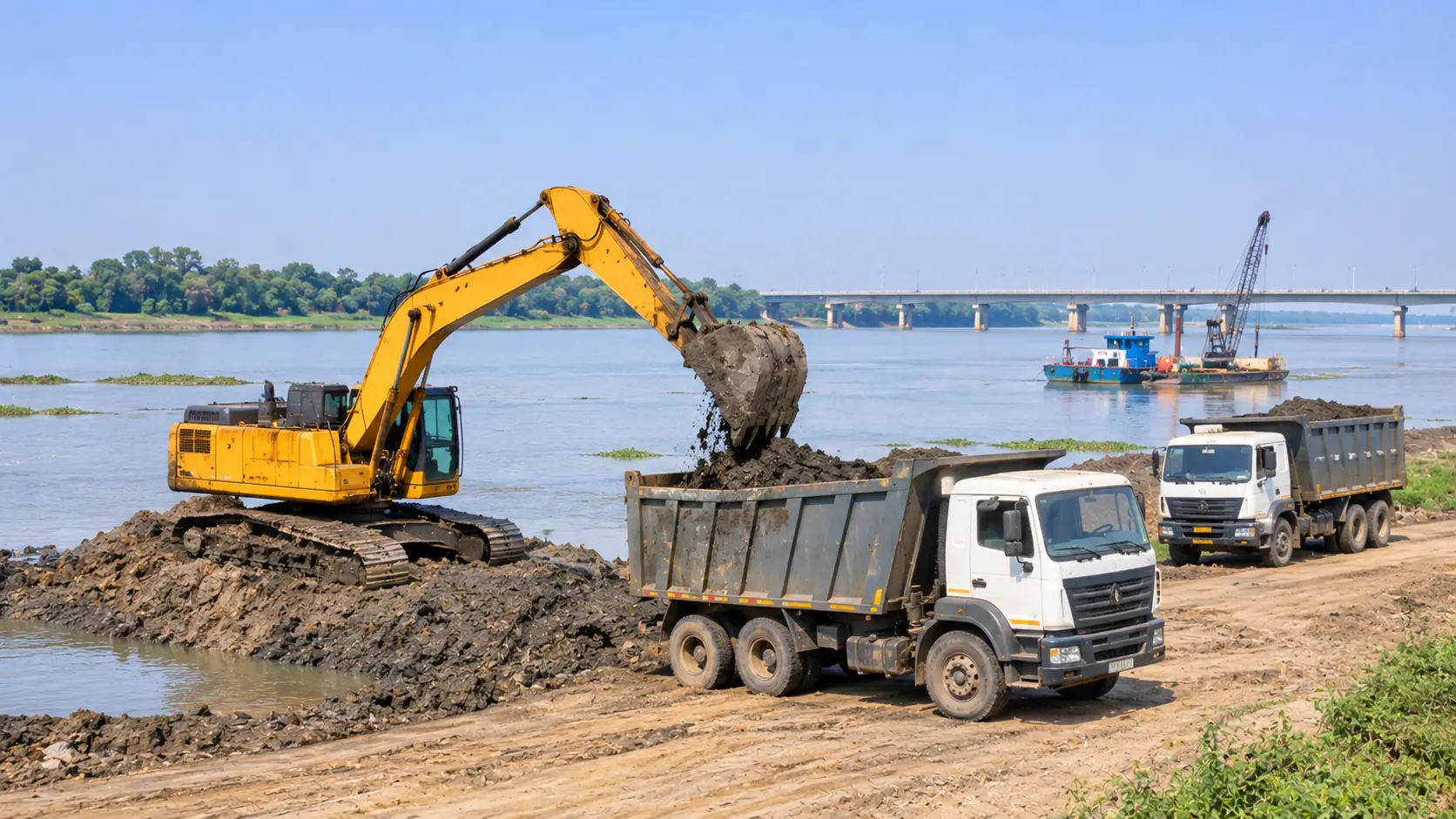
INDIA —The Ministry of Road Transport and Highways (MoRTH) has signed a Memorandum of Understanding with the Government of Bihar to integrate river desilting with road infrastructure construction. Formally launched as the 'Nadi Sanjivani' initiative, the agreement was executed in New Delhi in the presence of Union Minister Nitin Gadkari and Bihar Chief Minister Samrat Choudhary. The framework enables the scientific extraction of silt from local rivers and water bodies for direct application as embankment and fill material across regional highway projects.
The Ministry of Road Transport and Highways (MoRTH) is the apex federal ministry responsible for formulating and administering rules, regulations, and laws relating to road transport and national highway development in India. The National Highways Authority of India (NHAI) is an autonomous agency of the Central Government mandated to develop, maintain, and manage the national highway network. The Government of Bihar functions as the state governing authority, managing regional water resources, agricultural policy, and state road infrastructure networks.
Under the agreement, initial technical assessments have identified 24.3 million cubic metres of suitable excavated silt for deployment across 16 active national highway projects in Bihar. An additional 83.5 million cubic metres of silt is earmarked for integration into 27 planned highway developments, subject to technical testing under Indian Roads Congress specifications. Bihar's Road Construction Department will act as the nodal implementation agency, adhering to the Bihar Water Sources Restoration and Silt Management Policy, 2026, to oversee extraction protocols and environmental compliance.
This inter-agency framework offers significant commercial and environmental advantages by converting flood-causing river sediment into usable industrial aggregate. For infrastructure developers, engineering contractors, and environmental planners, replacing topsoil and fresh fill material with excavated silt lowers raw material procurement costs, preserves arable agricultural land, and accelerates the delivery of Bihar's 583.4 billion Indian rupee active highway pipeline.