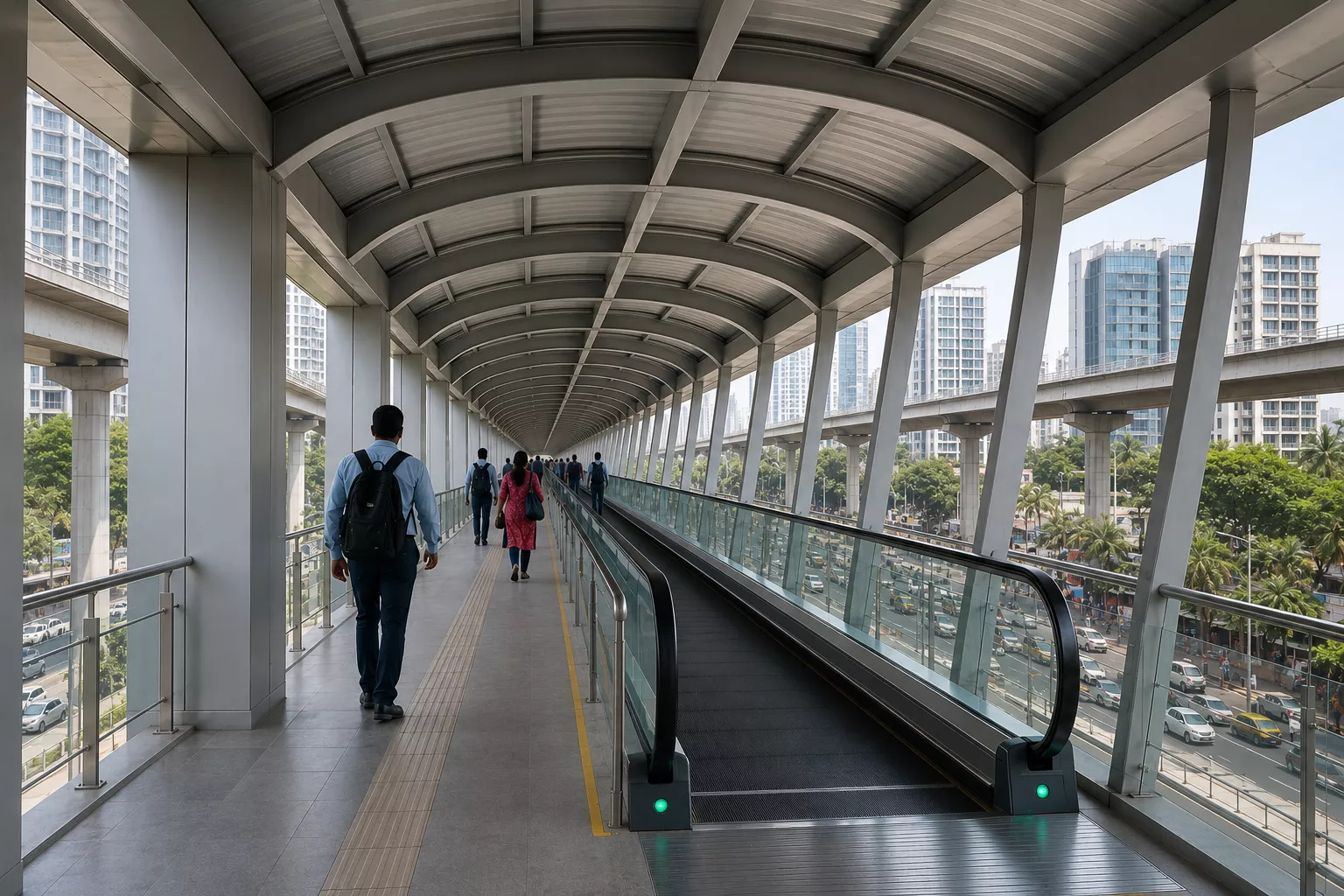
INDIA —Urban transit infrastructure in India's commercial capital is nearing a major operational milestone as construction reaches 90% completion on a high-capacity pedestrian interchange in South Mumbai. Executed by the Mumbai Metropolitan Region Development Authority (MMRDA), a state government body responsible for planning and coordinating infrastructure across the Mumbai Metropolitan Region, the Mahalaxmi Multimodal Connectivity Project establishes an integrated transit hub linking the Sant Gadge Maharaj Chowk Monorail Station, Metro Line 3, and the Mahalaxmi Suburban Railway Station.
Designed as India's first travellator-equipped skywalk, the infrastructure comprises a 283-metre-long, 11-metre-wide elevated pedestrian bridge equipped with six moving walkways totaling 176 metres in length, alongside two universal accessibility passenger lifts. The structure is engineered to accommodate an hourly throughput of approximately 4,500 passengers. To navigate dense underground utilities during civil works, engineering teams relocated an 1,800 mm diameter storm water drain without disturbing adjacent municipal water and sewer pipelines, executing construction within a congested urban corridor without requiring tree felling.
The development addresses long-standing urban mobility bottlenecks in South Mumbai, where modal fragmentation between suburban heavy rail, underground metro networks, and elevated monorail systems has traditionally increased transit friction. By enabling direct pedestrian transfer between three distinct transit systems, the facility is projected to reduce commuter interchange times by up to 20 minutes while enhancing regional access to major business districts including Worli and the broader South Mumbai commercial corridor.
From a public policy and city planning perspective, the project demonstrates a shift toward high-density multimodal integration in Indian megacities. Streamlining first- and last-mile connections across distinct transit operators optimizes existing mass transit investments, shifts commuter demand toward sustainable public transportation, and mitigates road traffic congestion across high-density urban corridors.
For urban developers, transport operators, and infrastructure investors, the successful implementation of high-capacity pedestrian interchanges in dense utility-congested environments establishes an engineering blueprint for future transit-oriented developments. Integrated transfer hubs enhance land values surrounding feeder stations, driving commercial real estate opportunities and increasing farebox revenues across interconnected transit networks.