NEPAL —Nepal has secured $305.75 million in multi-tranche funding from the Asian Development Bank (ADB) to finance major infrastructure upgrades along key national freight and transit corridors. The capital deployment comprises a $285 million ordinary capital resources loan, a $20 million grant dedicated to regional cooperation and integration, and $750,000 in technical assistance. The initiative targets the expansion of a 70-kilometer stretch of the East-West Highway between Narayanghat and Hetauda from two to four lanes, alongside the widening of an 8.7-kilometer section of the Prithvi Highway linking Kathmandu and Pokhara.
Established in 1966 and owned by 69 member nations, the Asian Development Bank (ADB) is a Manila-headquartered multilateral financial institution dedicated to promoting social and economic development across the Asia-Pacific region through loans, technical assistance, grants, and equity investments.
The strategic investment addresses severe capacity bottlenecks along vital trade routes connecting domestic industrial hubs with cross-border trade gateways under the South Asia Subregional Economic Cooperation program. Beyond lane expansion, the construction scope integrates climate-resilient engineering standards, including slope stabilization, reinforced embankments, enhanced drainage structures, and modern bridge design to withstand increasing flood and landslide hazards in mountainous terrains.
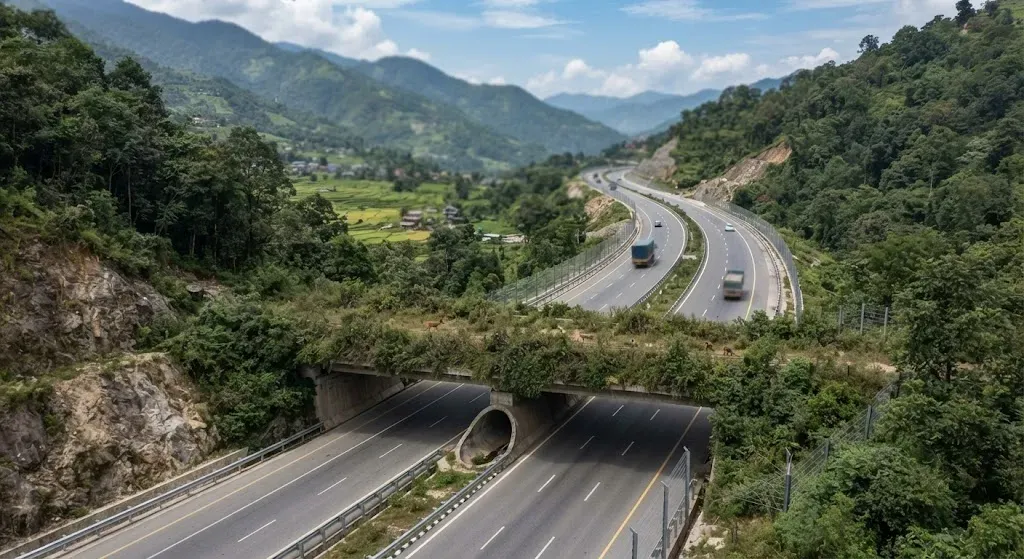
A core element of the capital allocation prioritizes ecological mitigation through green infrastructure design. To preserve biodiversity in the Terai Arc Landscape, the project includes an elevated highway structure spanning the Barandabhar wildlife corridor to restore natural animal migration routes and decrease vehicular collisions. Additional grant funding will sponsor eco-tourism initiatives, gender-inclusive workforce development programs, and capacity-building frameworks for sustainable transport planning.
For regional commerce and logistics operators, the corridor modernizations will significantly reduce transit times, lower vehicle operating costs, and improve supply chain reliability across Nepal's busiest commercial arteries. Engineering and construction firms stand to benefit from major procurement packages featuring specialized civil engineering work in terrain-resilient construction and biodiversity-friendly infrastructure integration.