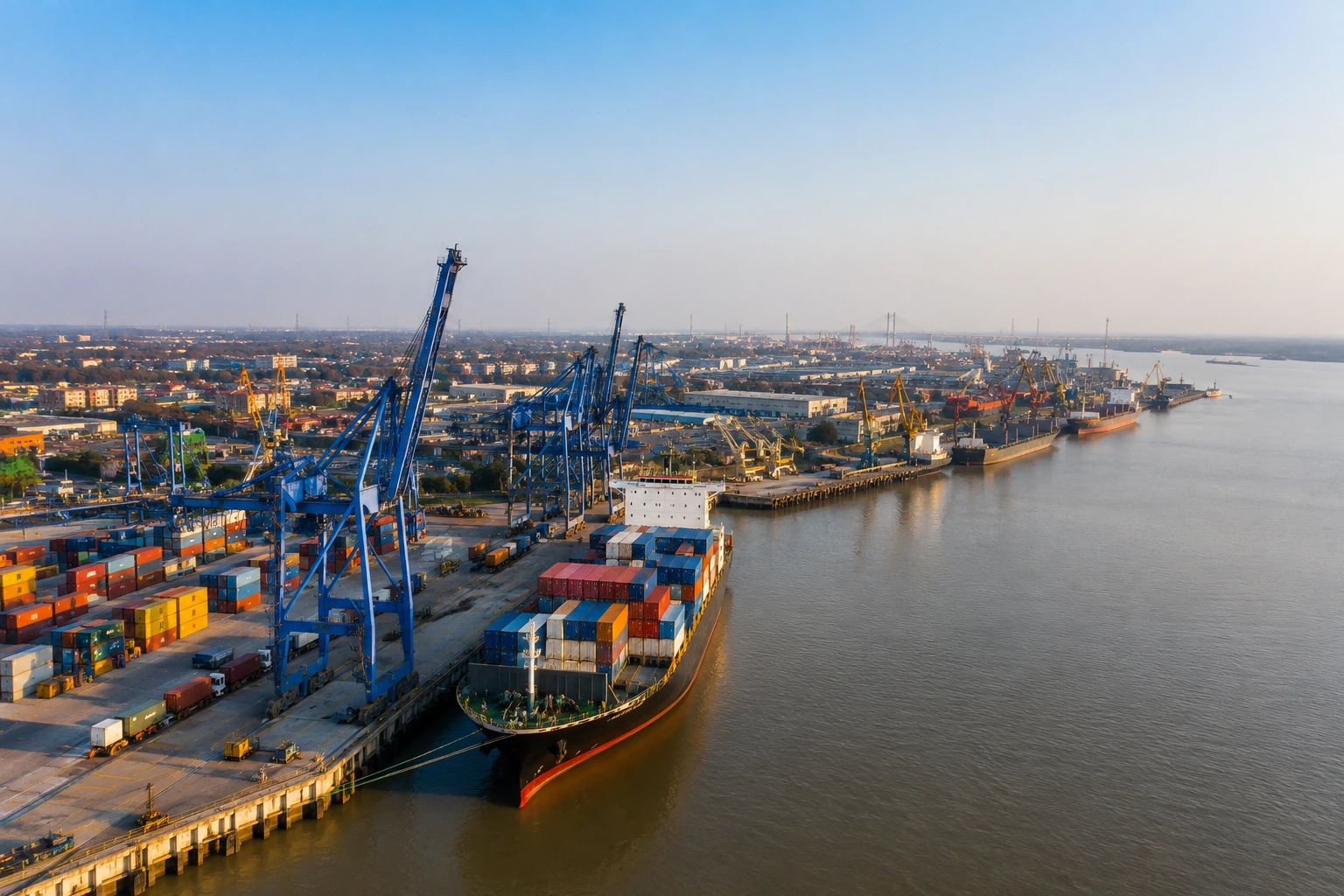
INDIA —India's Ministry of Ports, Shipping and Waterways has inaugurated seven major infrastructure developments valued at INR 4.28 billion at Paradip Port in Odisha, while overseeing the execution of concession agreements worth INR 15.80 billion for three berth mechanisation projects. The newly commissioned infrastructure includes an INR 3.52 billion capital dredging program to achieve an 18.5-metre draft, the INR 248.9 million Atharbanki Second New Bridge, and an Advanced Vessel Traffic Management and Information System developed alongside IIT Madras. Under the public-private partnership framework, concession agreements were finalized with Yogayatan Paradip SQB Terminal for the INR 4.99 billion South Quay project, Kalinga Bulk Terminal Paradip for the INR 6.31 billion Multipurpose Berth project, and AMNS Paradip Logistics for the INR 4.51 billion Captive CQ-III project. Paradip Port Authority is an autonomous public port trust on India's eastern seaboard, serving as a primary sea hub for mineral exports, coal, steel, and heavy industrial raw materials.
The inauguration of an 18.5-metre deep-draft capability marks an essential operational milestone for Paradip Port, enabling the facility to accommodate fully laden Capesize vessels without tidal dependencies. Higher vessel draft capacity significantly decreases per-tonne maritime freight costs by maximizing cargo intake per shipping call. Concurrently, mechanizing the three designated berths will add 23 million tonnes of annual cargo handling capacity. Transitioning manual operations to automated handling systems directly accelerates vessel turnaround times, enhances operational throughput, and reduces anchorage delays across busy Bay of Bengal trade lanes.
This infrastructure expansion aligns directly with the goals of India's national Maritime India Vision 2030, which focuses on port modernization, public-private partnership expansion, and logistics efficiency. Upgrading berth capacity and navigation systems supports major industrial sectors across Odisha, Jharkhand, and Chhattisgarh, including steel manufacturing, mining, and power generation. Furthermore, collaborating with domestic academic institutions for traffic monitoring technology reinforces broader policy efforts to integrate indigenous digital solutions into national transport infrastructure.
For commercial vessel operators, industrial exporters, and terminal developers, the upgrades strengthen Paradip Port's positioning as a premier bulk cargo gateway in South Asia. Long-term concession contracts provide terminal operators with reliable, revenue-generating assets backed by steady demand for coal, iron ore, and dry bulk commodities. Additionally, improved road connectivity and digitized vessel scheduling improve supply chain predictability for commercial shippers, helping reduce overall operational overheads across regional trade networks.