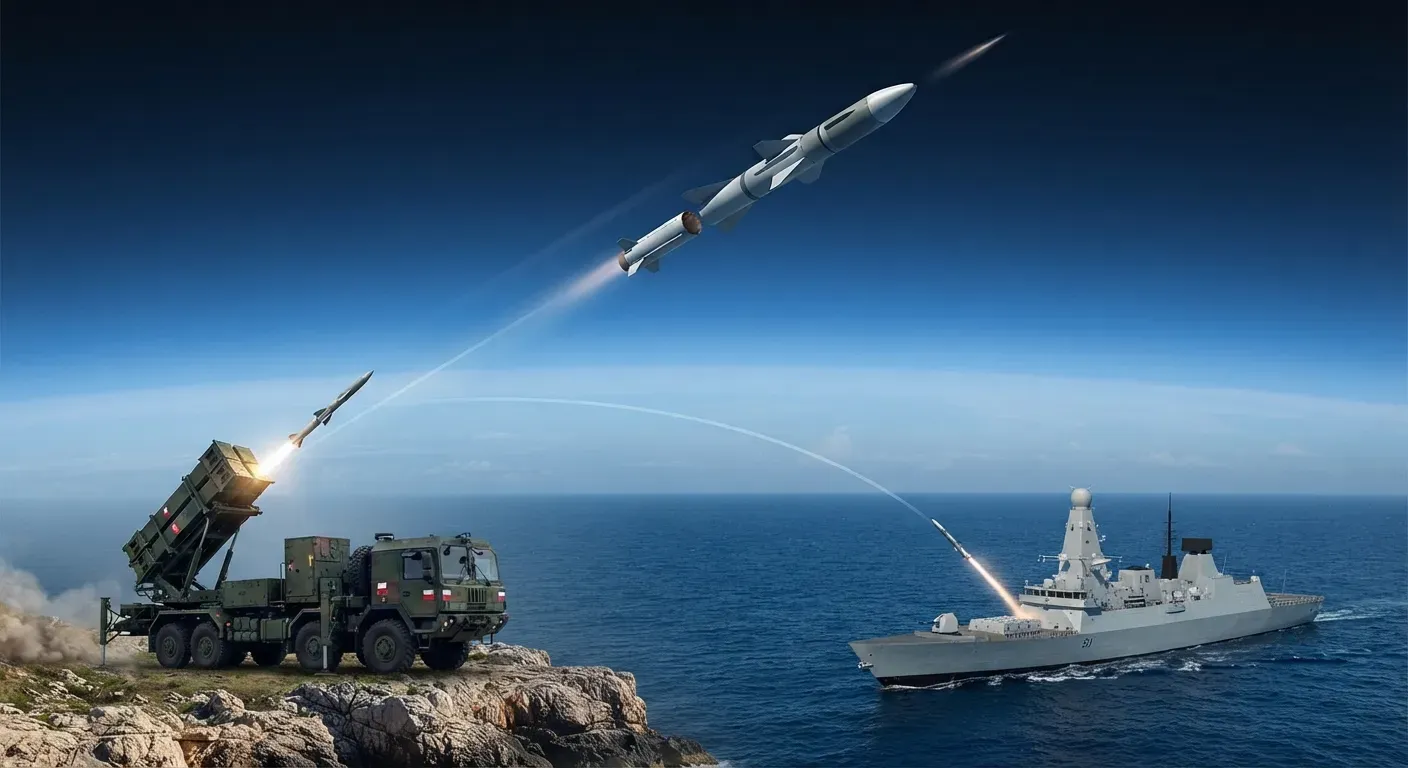
POLAND; UNITED KINGDOM —Warsaw and London have entered a bilateral research and development arrangement to co-fund and advance the CAMM-MR/FCM medium-range surface-to-air missile system. Currently positioned in its initial concept phase, the initiative expands the existing CAMM family toward a next-generation interceptor capable of engaging targets at ranges exceeding 100 kilometers. The system is designed for integration across both ground-based air defense batteries and naval vessels, addressing aerial threats including fixed-wing aircraft, helicopters, unmanned aerial vehicles, and cruise missiles.
This accord carries strategic significance as European governments accelerate air and missile defense modernization in response to evolving regional security pressures. By pairing British missile engineering expertise with Polish industrial participation, the agreement moves beyond off-the-shelf procurement toward co-development and shared intellectual property. The Polish Armaments Group, known as PGZ, is a state-owned defense holding company that coordinates manufacturing, maintenance, and modernization across major Polish defense enterprises. Alongside other domestic defense firms and research institutions, PGZ is positioned to absorb technical know-how and scale domestic production capacity for complex missile subsystems.
Across the defense and industrial sectors, the partnership affects aerospace primes, propulsion and seeker suppliers, naval integrators, and specialized R&D institutes in both Poland and the United Kingdom. For policymakers, bilateral co-development reinforces NATO interoperability along Europe's eastern flank while supporting sovereign industrial resilience. Rather than relying solely on external supply chains, participating governments gain greater long-term control over manufacturing throughput, lifecycle support, and export alignment among allied partners.
For defense contractors, prime integrators, and institutional investors tracking European security spending, early-stage concept agreements serve as a leading indicator of multi-year budget commitments and industrial workshare allocation. Firms capable of delivering modular air defense electronics, propulsion technologies, and dual land-sea integration stand to benefit as programs transition from conceptual design to engineering and production phases. Conversely, suppliers unable to localize manufacturing or meet cross-border security and technical standards may face heightened competition as European defense procurement increasingly favors co-developed platforms.