PORTUGAL —Brussels has issued a positive preliminary assessment for Portugal's tenth and final payment request worth EUR 4.7 billion under the Recovery and Resilience Facility (RRF), the central funding mechanism of NextGenerationEU. Following the September 29, 2026 submission, EU reviewers verified that Lisbon fulfilled all 29 milestones and 67 targets attached to this tranche, bringing total completed commitments across the national recovery plan to 379 milestones and targets and unlocking the full EUR 21.9 billion envelope split into EUR 16.3 billion in grants and EUR 5.6 billion in loans. The Economic and Financial Committee now has four weeks to deliver its opinion before formal payment adoption, as member states observe the late-August implementation cutoff and year-end program closeout.
Achieving full disbursement matters because it transitions Portugal from pandemic-era recovery disbursements to post-facility fiscal and operational execution across priority public systems. The European Commission operates as the executive arm of the European Union responsible for proposing legislation, managing EU budget programs, and assessing member-state compliance with policy benchmarks. Rather than leaving capital stranded near the program's wind-down, full milestone completion converts committed EU resources into tangible domestic assets and structural adjustments across public administration and social safety nets.
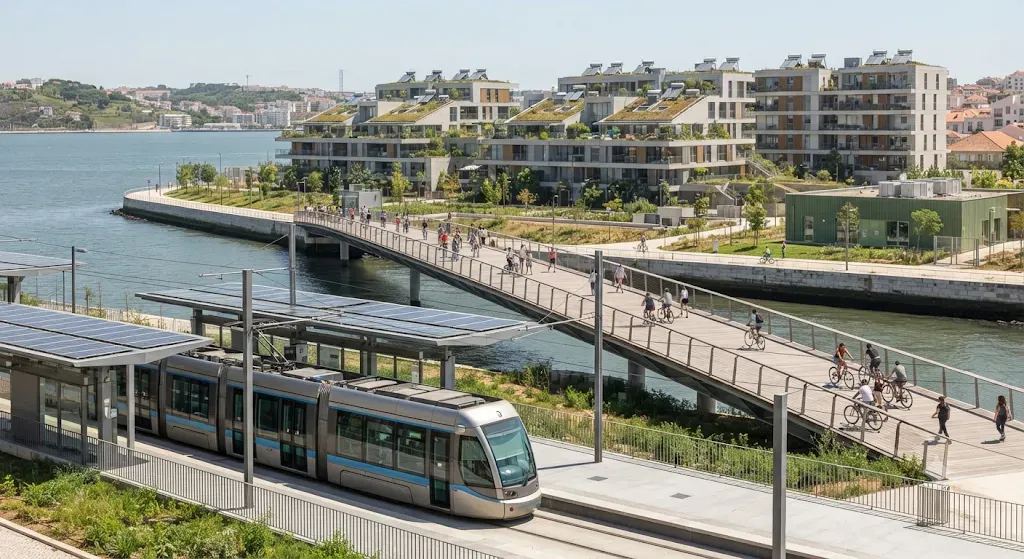
Sectoral effects span social welfare, housing, healthcare, power generation, and urban transit. Lisbon is consolidating support under a Single Social Benefit framework while revising at least eight existing programs, including minimum income support, alongside tax simplification and business competitiveness measures. In physical infrastructure, the package covers 20,801 housing solutions under the 1.º Direito initiative, more than 2,200 additional beds across integrated continued, mental, and palliative care supported by facility upgrades and emergency medical equipment, 860 zero-emission buses nationwide, and 11 MW of wind and solar capacity paired with storage enabling Porto Santo to draw local renewable electricity for over two hundred days annually.
For corporate operators, contractors, and institutional investors, full tranche approval reduces policy uncertainty around publicly backed capital projects while shifting attention toward long-term operating sustainability. Suppliers in grid integration, battery storage, electric transit fleets, healthcare facilities, and construction face completion and maintenance phases rather than initial grant allocation. Meanwhile, social benefit streamlining and tax simplification alter household purchasing dynamics and compliance conditions for domestic enterprises as EU recovery funding winds down at the close of 2026.