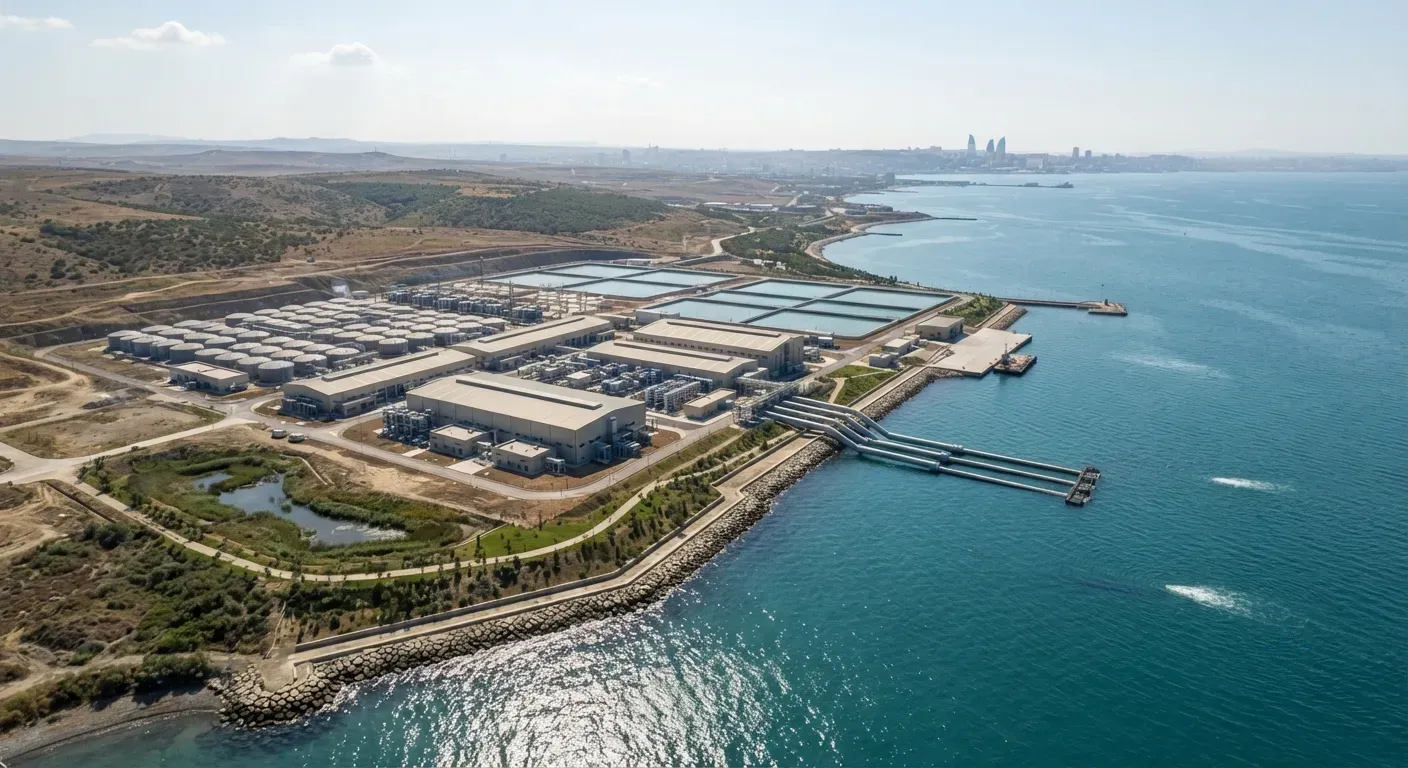
AZERBAIJAN —Financing approval from the Asian Development Bank (ADB) unlocks $140 million for a public-private partnership (PPP) designed to deliver Azerbaijan's first large-scale seawater desalination facility drawing from the Caspian Sea. The project covers engineering, construction, financing, operations, and maintenance for a reverse osmosis plant rated at a contracted output of 300,000 cubic meters per day, with peak-demand flexibility reaching 330,000 cubic meters per day alongside supporting works. Once operational, treated water will be sold exclusively to the state-owned United Water Supply Services of Major Cities under a 25-year concession structure.
The Asian Development Bank (ADB) is a multilateral development bank focused on sustainable economic growth, infrastructure, and institutional development across Asia and the Pacific. Operating as a regional partner for public and private investment, it finances capital-intensive projects while enforcing safeguard standards across environmental, social, and governance dimensions. Within Azerbaijan, the initiative aligns with the bank's 2025-2029 country partnership strategy prioritizing low-carbon connectivity, resilient infrastructure, and private-sector participation.
For Azerbaijan, shifting part of urban water supply toward desalinated Caspian water introduces a non-traditional source into municipal utility planning while testing a long-duration public-private partnership (PPP) in water infrastructure. Because the facility uses reverse osmosis and a 25-year contract horizon, project economics depend on steady municipal offtake, reliable power supply, and disciplined lifecycle maintenance rather than short-term fiscal outlays alone.
Water utilities, engineering and construction contractors, membrane and pumping technology suppliers, and project financiers face distinct operational and regulatory demands on this transaction. The bank classifies overall environmental and social risk as substantial, citing marine works and dredging, seawater intake and brine discharge, sensitive marine habitats, legacy brownfield contamination, and unfinalized details around the water transmission pipeline and final engineering. Meeting mitigation plans, environmental assessments, and action plans will directly govern permitting timelines and cost control.
For commercial sponsors, lenders, and equipment vendors evaluating future water and infrastructure concessions in the South Caucasus and Caspian basin, this approval serves as a reference case for bankable public-private risk allocation. Developers that can price brownfield remediation, marine discharge compliance, and transmission interface risks upfront will be better positioned as governments use concession models to modernize municipal utilities.