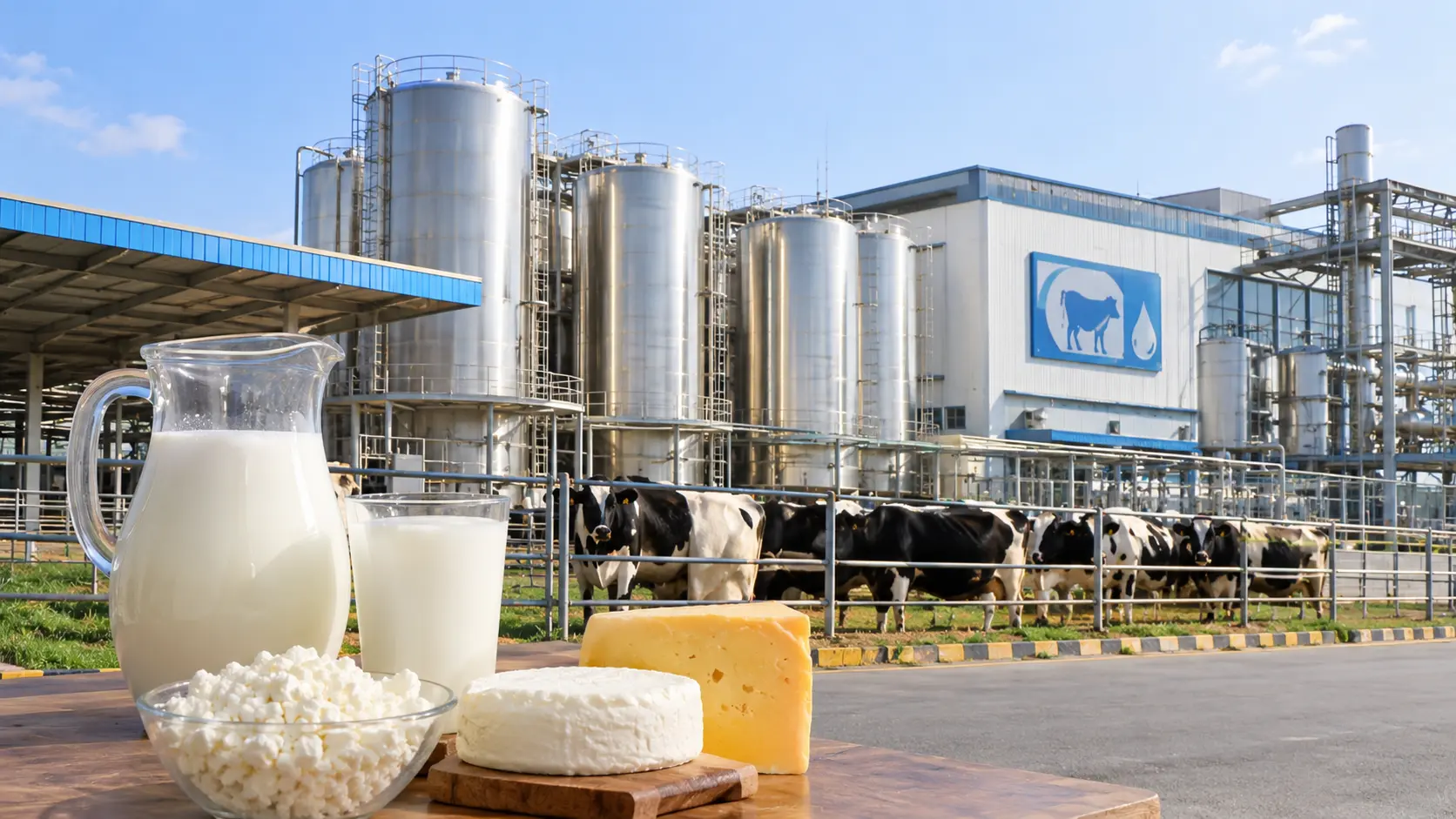
INDIA —Prime Minister Narendra Modi has officially inaugurated three infrastructure projects valued at a combined 4.07 billion Indian rupees for Banas Dairy in the Banaskantha district of Gujarat. The completed projects comprise the 3.24 billion Indian rupee Bharat Bovine Breeding and Research Centre at Bhildi, a 516.5 million Indian rupee French fries processing plant expansion at Sanadar, and a 311.4 million Indian rupee Automated Storage and Retrieval System in Palanpur. Concurrently, foundation stones were laid for two Bio-CNG processing units at Tharad and Radhanpur with daily cattle dung treatment capacities of 75 metric tonnes and 100 metric tonnes, respectively.
Banas Dairy, affiliated with the Gujarat Cooperative Milk Marketing Federation, is one of Asia's largest dairy cooperative organizations, managing milk procurement, processing, and agricultural product distribution across western India. The National Dairy Development Board is a statutory body under the Ministry of Fisheries, Animal Husbandry and Dairying, Government of India, tasked with promoting and financing dairy sector development nationwide.
The newly commissioned infrastructure expands Banas Dairy's operations beyond core liquid milk processing into high-value agricultural supply chains and renewable energy production. The 127-acre bovine research center, developed with partial funding from the central government's Rashtriya Gokul Mission and NABARD, focuses on genetic cattle improvement. The Palanpur automated logistics facility features a nine-level steel-rack warehousing architecture accommodating 11,000 pallets for ultra-high-temperature milk products, while the upgraded Sanadar plant boosts potato processing capacity to five tonnes per hour using an integrated farm-to-factory model.
This multi-sector investment highlights the growing modernization of cooperative agricultural networks in South Asia. For food processors, logistics technology providers, and renewable energy developers, scaling automated supply chains and commercializing livestock waste into Bio-CNG creates secondary revenue streams for rural producers, reduces warehousing overheads, and aligns agricultural operations with national decarbonization targets.