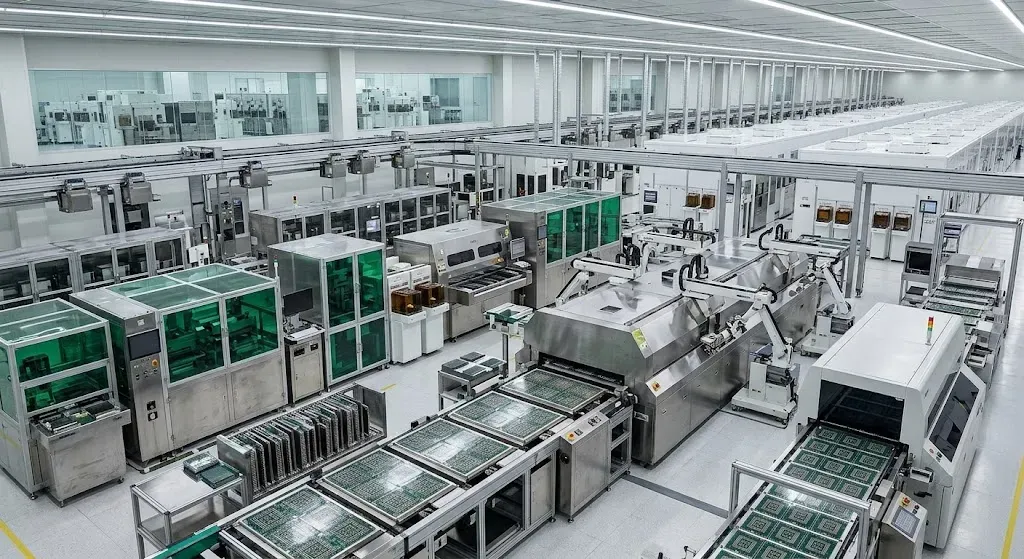
KOREA (SOUTH); VIETNAM —South Korea’s component manufacturing sector is scaling up to meet the intense global demand for advanced AI infrastructure components. According to corporate disclosures, Samsung Electro-Mechanics will commit approximately KRW 6.78 trillion to expand its production capacity for high-performance Flip Chip-Ball Grid Array (FCBGA) semiconductor substrates. The capital deployment is structured across two primary manufacturing hubs, directing KRW 4.27 trillion toward the company's Sejong business site in South Korea and KRW 2.51 trillion to its production subsidiary in Vietnam.
The domestic investment at the Sejong facility represents the company's largest-ever capital commitment for a single product category. With an investment period scheduled from September 2026 through May 2028, mass production at the newly expanded Korean site is targeted to commence in September 2028. Concurrently, the Vietnamese expansion aims for construction completion and operational readiness by June 2030. FCBGA substrates serve as critical interfaces that connect high-performance chips such as AI accelerators, GPUs, and CPUs, to main circuit boards, facilitating high-speed power and data transmission essential for maintaining system stability in compute-intensive environments.
To mitigate the financial risks typically associated with massive capacity buildouts, Samsung Electro-Mechanics has secured strategic funding support and medium- to long-term volume guarantees from global big tech and semiconductor clients. Securing upfront capital commitments from buyers highlights the tightening supply chain for advanced packaging components, as major technology firms prioritize supply assurance for large-area, high-layer-count substrates required for next-generation AI and high-performance computing (HPC) applications.
From an industry and supply chain perspective, the dual-site expansion strategy establishes a highly resilient manufacturing footprint. The Sejong site will act as the primary hub for highly complex, next-generation AI server substrates, while the Vietnamese base provides a strategic platform to manage global volume demands efficiently. For institutional investors and technology hardware analysts, the multi-billion-dollar expansion validates sustained, long-term growth forecasts for specialized AI hardware, positioning the company to capture expanding market share in premium semiconductor packaging.