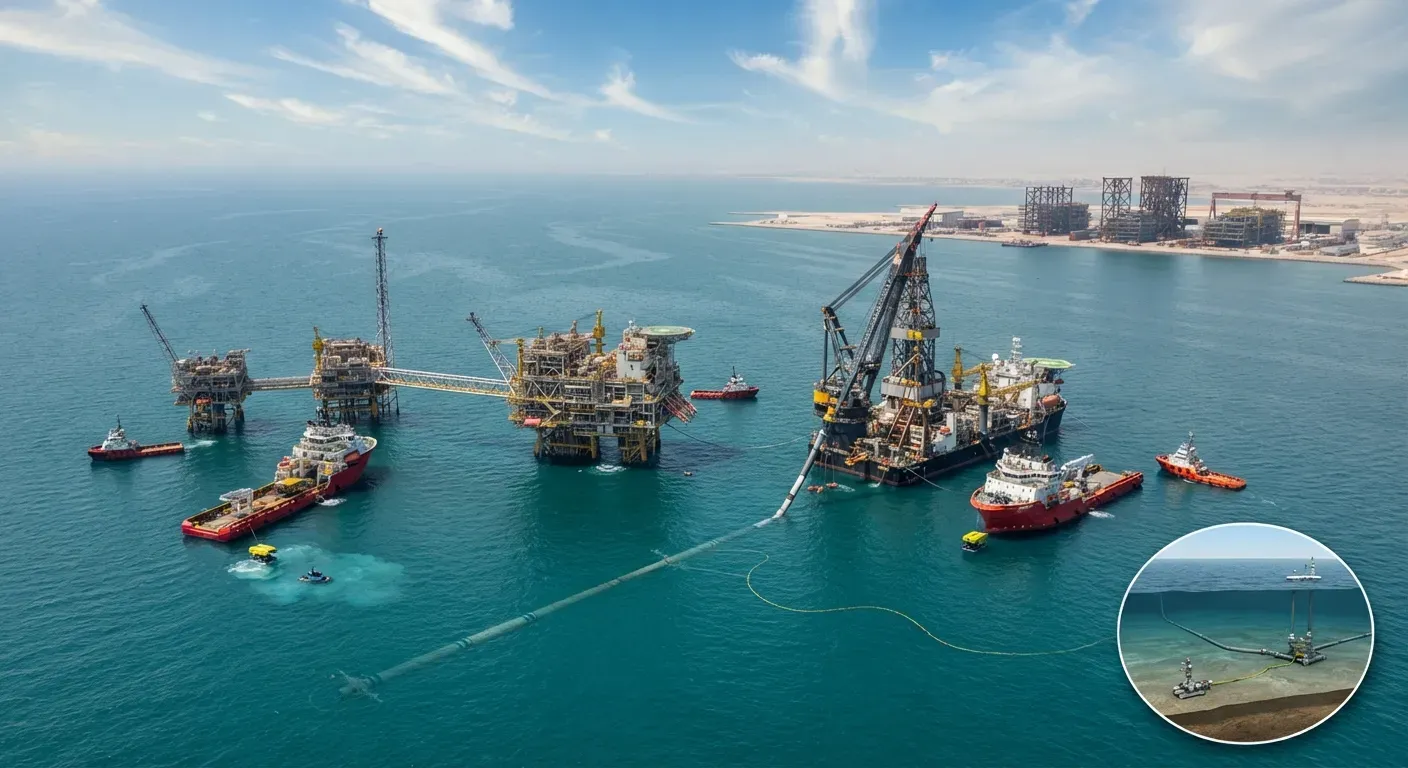
SAUDI ARABIA —Italian contractor Saipem has received two offshore engineering, procurement, construction, and installation awards from Saudi Aramco under an existing long-term framework agreement. Known as Contract Release Purchase Orders (CRPO), the two packages cover offshore facilities, pipelines, power cables, and subsea infrastructure across major fields in Saudi Arabia.
Under the first package, designated CRPO 168, scope encompasses four production deck manifolds, roughly 14 kilometers of 12-to-16-inch pipelines, and approximately 24 kilometers of 15-kilovolt cables. Execution spans the Abu Safah, Safaniyah, Manifa, and Berri fields, incorporating related subsea assets and onshore tie-in work at a Manifa field drill site. The second package, CRPO 170, covers three production deck manifolds, around 25 kilometers of 12-to-16-inch pipelines, about 17 kilometers of 15-kilovolt cables, and associated subsea equipment at the Marjan field.
Saipem is an Italian engineering and construction firm operating in more than 50 countries with roughly 30,000 employees. Its offshore marine fleet includes 17 owned construction vessels and seven drilling rigs.
These awards matter because they demonstrate sustained capital deployment toward brownfield and offshore field maintenance and tie-in infrastructure in the Persian Gulf. For oil and gas producers, reliable deck manifolds, medium-voltage cabling, and short-to-medium-haul pipelines are essential to sustain reservoir output, maintain power distribution, and integrate subsea wells into existing processing networks.
The developments affect offshore oil and gas operators, subsea equipment suppliers, marine construction contractors, and domestic industrial fabricators in Saudi Arabia. Offshore fabrication is slated to take place at a local facility operated by Saipem Taqa Al-Rushaid Fabricators, while marine installation relies on construction vessels already active in the region.
From a market and strategic standpoint, routing fabrication through an in-country joint venture supports localization priorities and reduces cross-border supply bottlenecks. Utilizing regionally stationed vessels also helps limit mobilization delays and transit exposure in Gulf waters, while reinforcing long-term backlog visibility for offshore EPCI providers aligned with national energy operators.