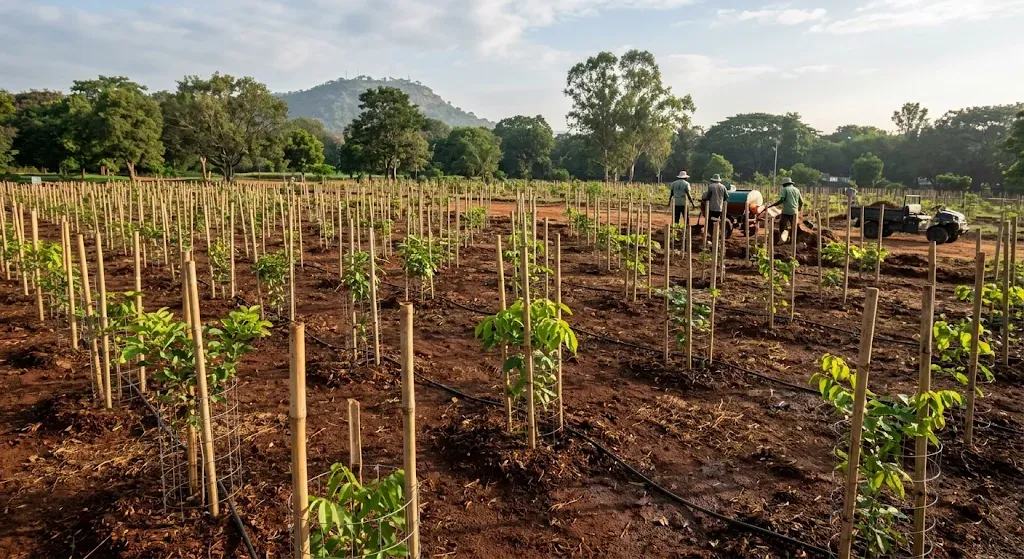
INDIA —A large-scale urban greening initiative titled Bharat Vann has been formally initiated in Mysuru to expand regional canopy coverage and improve local environmental indices. The program involves planting two lakh native saplings across multiple municipal parks and designated green zones throughout the city. The State Bank of India and the SBI Foundation are financing the undertaking through their corporate social responsibility channels, partnering with specialized ecological entities including the Catch Foundation and the Enviro Creators Foundation to execute plantation activities. Local municipal authorities are provisioning required land parcels and continuous water infrastructure to support sapling growth.
This initiative carries significant strategic weight for urban planners and environmental stakeholders navigating rapid metropolitan expansion. Urban forestry projects of this scale directly address localized heat island effects, mitigate particulate matter accumulation, and strengthen urban biodiversity corridors. By committing implementing partners to a mandatory three-year nurturing and protection phase, the project mitigates the historically high mortality rates associated with unmonitored municipal tree-planting drives, ensuring genuine ecological gains rather than short-term optical metrics.
The deployment directly impacts municipal governance frameworks, corporate social responsibility investors, and regional urban development entities across Karnataka. Financial institutions and corporate donors increasingly evaluate environmental, social, and governance compliance through measurable, long-term ecological interventions rather than transactional contributions. For municipal corporations, this collaborative model offers a sustainable template for leveraging private sector capital and specialized non-profit execution capabilities to achieve mandated urban green cover targets without straining public fiscal resources.
From an investment and strategic policy perspective, this project sets a benchmark for corporate-backed urban ecological stewardship. Institutional stakeholders and municipal bodies are expected to replicate this tripartite model-combining corporate funding, specialized NGO execution, and municipal land provisioning-across other Tier-2 and Tier-3 urban centers facing ecological degradation. Real estate developers and urban infrastructure planners must factor expanding green perimeters into long-term commercial valuations, as urban microclimates and air quality index ratings increasingly influence corporate relocation and residential investment decisions.