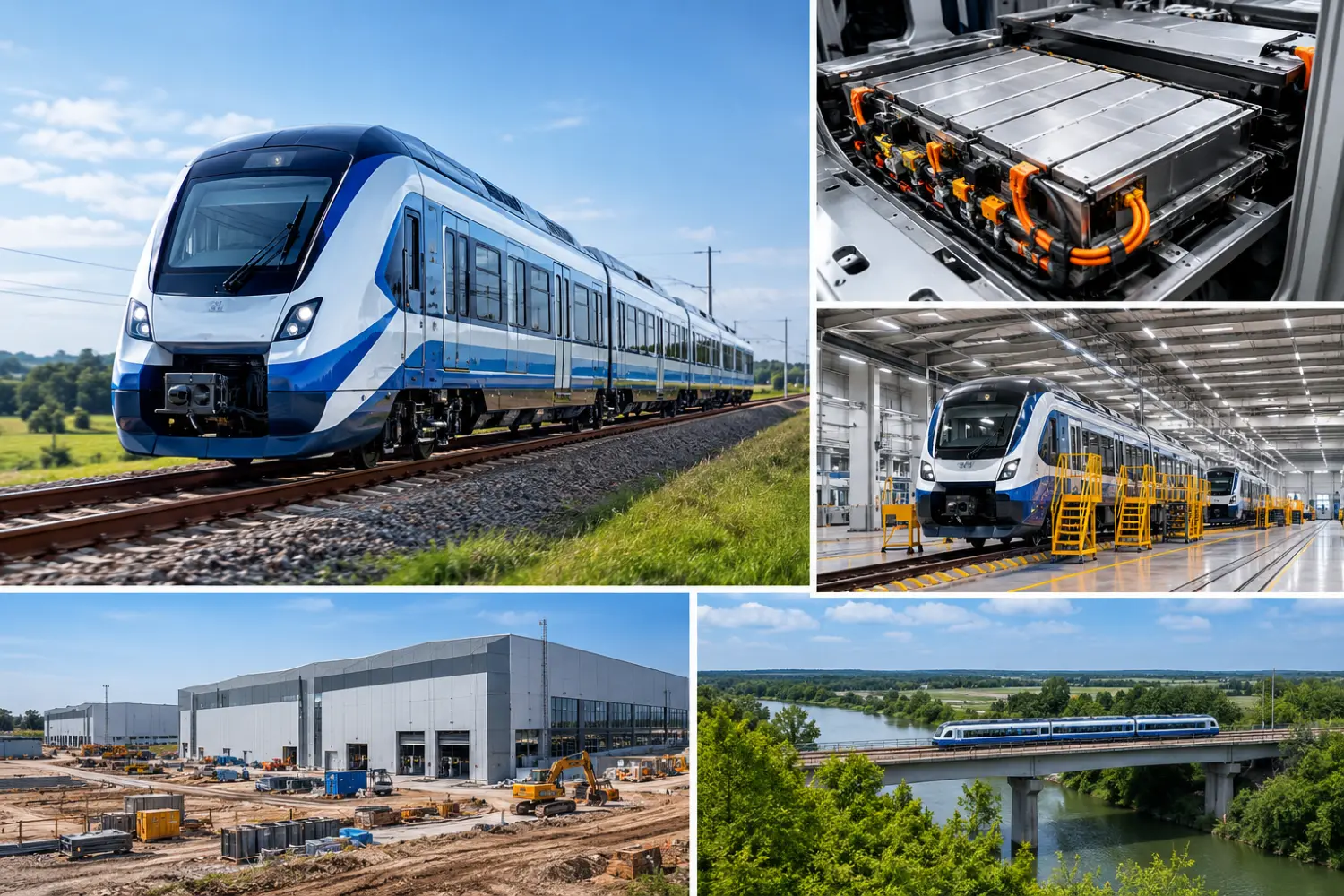
GERMANY —Two regional transport authorities in Lower Saxony have commissioned Siemens Mobility to deliver a major battery-electric rail fleet, combining rolling stock procurement with long-term maintenance infrastructure. The agreement covers 113 three-car Mireo Plus B trains and is valued at more than EUR 2 billion. Passenger services using the new vehicles are scheduled to start towards the end of 2031.
The procurement allocates 83 trains to Landesnahverkehrsgesellschaft Niedersachsen (LNVG), the transport authority responsible for regional rail services in Lower Saxony, while the Regionalverband Großraum Braunschweig (RGB), which coordinates regional transport planning in the Braunschweig area, will receive 30. The contract also provides for the construction of two Rail Service Centers in Lower Saxony and a 30-year maintenance programme supported by digital maintenance capabilities.
The scale of the agreement makes it a combined fleet-renewal and lifecycle-support investment rather than a standalone train purchase. Battery-powered regional trains can support rail operations on routes where full electrification is unavailable or uneconomic, reducing dependence on diesel traction. Their deployment could therefore help regional authorities expand lower-emission rail services without requiring overhead electrical infrastructure across every route.
The two new service centres are expected to strengthen local maintenance capacity, with the programme identifying the potential to create up to 100 future-oriented jobs. The facilities will also provide a regional base for inspections, servicing and fleet support. Integrating maintenance into a long-duration contract gives the authorities a framework for managing vehicle availability and technical support over an extended operating period, although the announcement does not detail performance targets or the allocation of lifecycle costs.
The agreement includes options to procure as many as 132 further trains, creating scope for a substantial expansion beyond the initial 113 vehicles. Exercising these options would depend on future requirements, funding and procurement decisions; they should not be treated as confirmed orders. Nevertheless, the provision gives the authorities flexibility to respond to changes in passenger demand and regional rail-service planning.
For Siemens Mobility, the contract combines manufacturing revenue with a long-term service commitment and potential follow-on vehicle sales. The maintenance component extends the commercial relationship well beyond initial delivery, while the planned service centres create local operational capacity. For suppliers of batteries, traction systems, onboard electronics and railway maintenance equipment, the programme may generate associated opportunities as implementation advances.
Siemens Mobility is the rail transport business of Siemens, supplying rolling stock, railway automation, electrification and related services. LNVG and RGB represent public-sector transport interests in Lower Saxony, where the investment links regional fleet modernisation with infrastructure development and long-term service planning. The first passenger operations are planned for late 2031, leaving several years for train production, facility development and operational preparation.