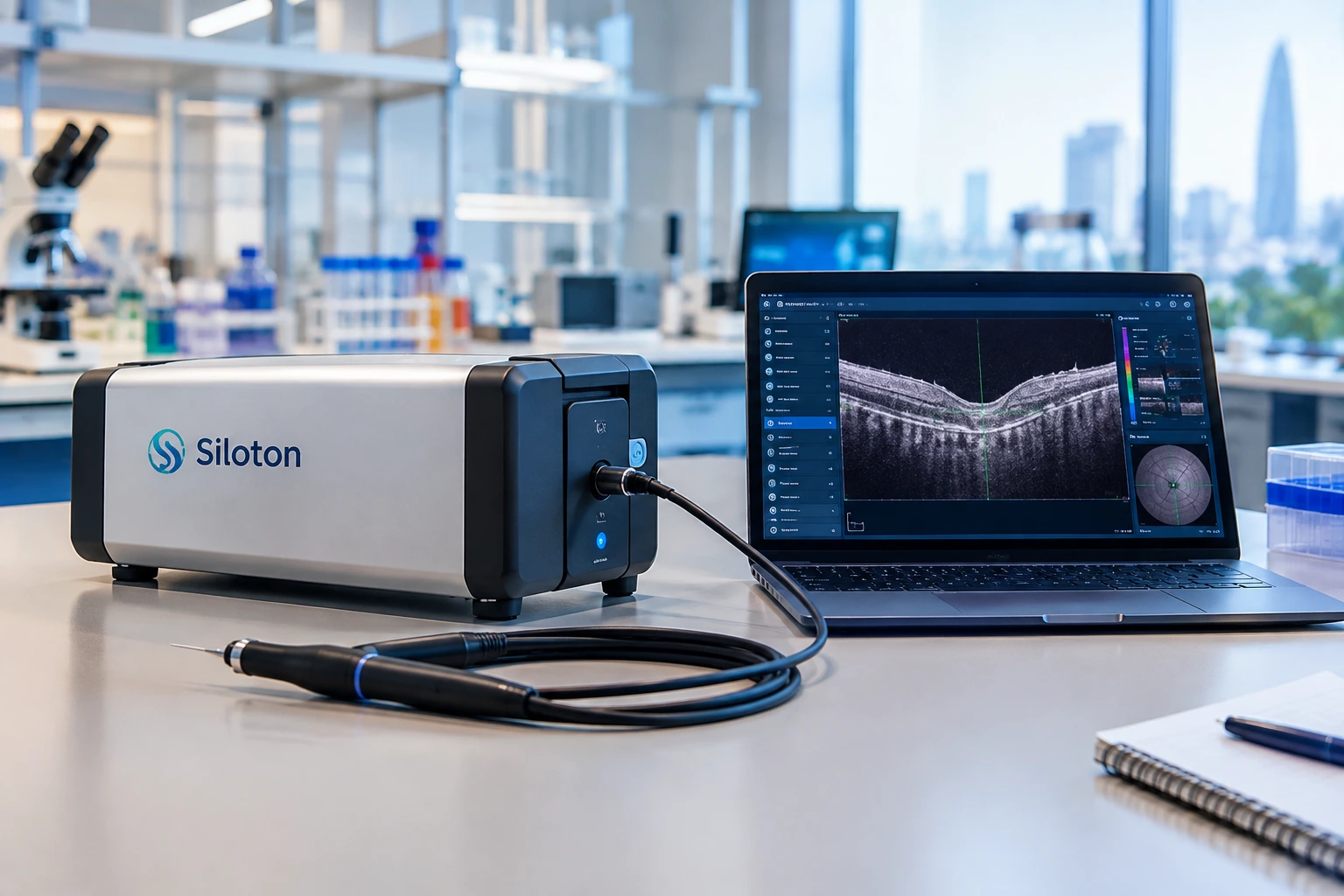
UNITED KINGDOM —Medical technology enterprise Siloton has been awarded an 8.4 million GBP commercial contract by Innovate UK under the Contracts for Innovation: Quantum Missions Primer program. The funding will support a two-year project aimed at refining, miniaturizing, and conducting clinical trials for both in-clinic and at-home variants of the company's GiraffeOCT retinal imaging system. Siloton is a Bristol-headquartered med-tech firm specializing in photonic chip technology designed to downsize optical coherence tomography components into portable, low-cost diagnostic hardware.
The strategic commercial agreement focuses on validating the portable diagnostic hardware in collaboration with Sunderland Specialist Eye Hospital, alongside economic modeling executed by York Health Economics Consortium to evaluate cost savings within public healthcare frameworks. By utilizing integrated photonics, the system compresses heavy optical components onto a microchip smaller than a coin, enabling high-precision retinal scanning outside traditional hospital settings. The two-year development program is projected to truncate product development timelines by up to two years, while supporting team expansion in fields such as photonics, electronics, and software engineering.
The development addresses significant operational bottlenecks in healthcare infrastructure, particularly within ophthalmology services where appointment backlogs remain substantial. Delivering clinical-grade optical coherence tomography into community centers and home care aligns with broader public policy initiatives aimed at transitioning patient care from centralized hospital facilities to decentralized primary care networks. Furthermore, advancing quantum sensing applications in healthcare supports national technology mandates that target early diagnostic deployment across public health systems.
From an investment and industry perspective, the non-dilutive contract funding strengthens Siloton's capital position as it prepares for subsequent investment rounds and advances its next-generation photonic chip architecture. Widespread adoption of miniaturized optical coherence devices threatens to disrupt the traditional diagnostic imaging market, which relies heavily on costly, stationary tabletop hardware. Successful commercial scaling creates opportunities for broader integration with cloud-based diagnostic platforms, remote patient monitoring networks, and specialized application environments requiring compact diagnostic tools.