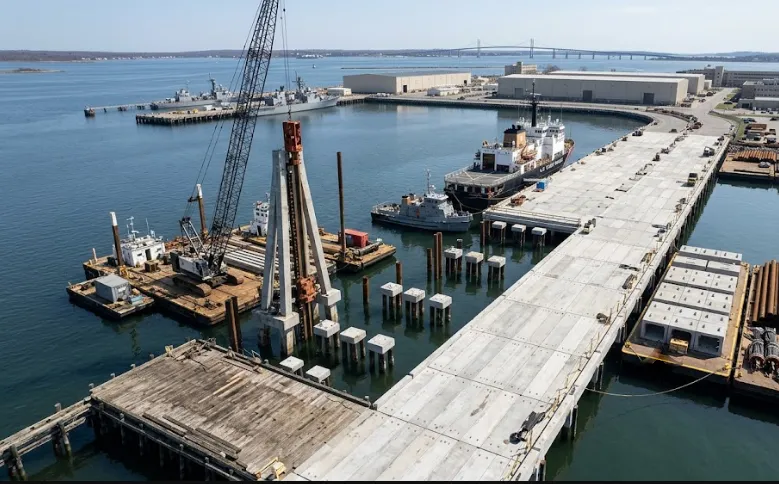
UNITED STATES OF AMERICA —A major infrastructure overhaul is underway at Naval Station Newport as federal defense authorities advance efforts to modernize maritime operational capabilities. Under a newly awarded USD 271 million agreement with NAVFAC Mid-Atlantic, construction firm Skanska will execute the comprehensive replacement of the facility's legacy Pier 1 in Rhode Island. The project revenue will be recognized in the contractor's third-quarter order bookings for 2026, with full construction completion targeted for March 2030.
The undertaking involves replacing the older 30-meter by 482-meter pier structure with a redesigned 24-meter by 305-meter facility engineered to berth up to four U.S. Coast Guard Offshore Patrol Cutters. Construction activities encompass demolishing the existing footprint, establishing 8 meters of new bulkhead, site improvements, and extensive dredging. To support active vessel berthing, the upgraded installation will feature integrated utility infrastructure, including dedicated substations, compressed air systems, and modernized water and wastewater networks.
Skanska is an international construction and project development group headquartered in Sweden, operating across select markets in Europe and North America. The firm delivers large-scale civil engineering, commercial building, and residential development projects, generating SEK 179 billion in revenue in 2025. Naval Facilities Engineering Systems Command Mid-Atlantic serves as the shore facility command overseeing engineering, acquisition, and public works support for U.S. Navy installations across the mid-Atlantic region.
This development highlights sustained federal capital investment in aging defense and maritime assets along the U.S. Eastern Seaboard. By upgrading military berthing capacity and associated utilities, the project directly strengthens coastal defense readiness and fleet deployment efficiency. Marine engineering firms, specialized defense subcontractors, and heavy construction equipment suppliers stand to benefit from the sustained procurement activity generated over the multi-year timeline.
For institutional investors and construction sector analysts, the deal underscores the strategic stability provided by public sector defense contracts during fluctuating macroeconomic cycles. Federal infrastructure programs offer long-term revenue visibility for Tier-1 contractors capable of navigating complex regulatory and naval defense engineering specifications.