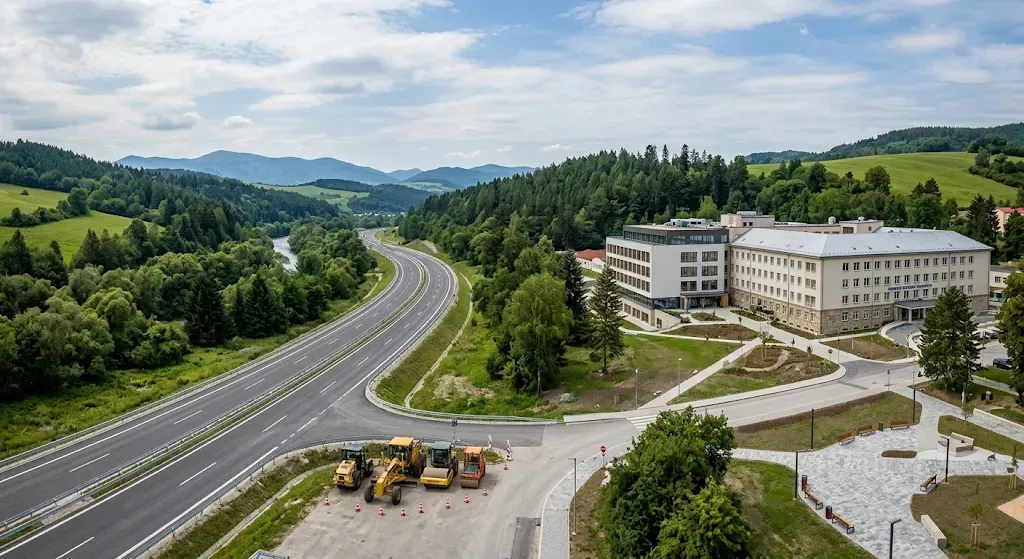
SLOVAKIA (SLOVAK REPUBLIC) —The Banská Bystrica regional authority in Slovakia has finalized a financial arrangement totaling 25 million euros to accelerate structural improvements across its territory. The funding structure comprises a 20 million euro debt financing agreement issued by the European Investment Bank (EIB) alongside a 5 million euro non-repayable grant originating from European Union instruments. These combined financial allocations are designed to catalyze a broader regional capital expenditure program valued at approximately 36.5 million euros over a four-year execution timeline. Headquartered in Luxembourg, the European Investment Bank (EIB) functions as the long-term lending institution of the European Union (EU), owned collectively by its member states to finance projects supporting policy objectives including territorial cohesion, social infrastructure, and climate action. Within the administrative scope of this initiative, approximately 100 distinct capital projects will be deployed throughout all municipal districts of the territory, encompassing upgrades to public educational facilities, social welfare centers, cultural architecture, and regional transport networks such as local roadways and mountain transit connections.
This capital injection carries substantial significance for the region by addressing structural deficits related to demographic shifts, economic restructuring, and aging public amenities. As the geographically largest self-governing administrative division in the country, the territory contends with distinct developmental disparities and manages an extensive network of secondary and tertiary roads alongside vital community services. The integration of international banking debt with structural transition funding provides local governing bodies with the fiscal capacity to modernize foundational assets without overextending municipal budgets. Furthermore, the deployment of advanced digital public governance tools alongside physical construction elements aims to enhance administrative efficiency and long-term economic resilience for the local population.
The intervention falls under the broader framework of European cohesion policy and the regulatory architecture established to manage the socioeconomic impacts of industrial and energy transitions. Specifically, the financing utilizes the Just Transition Mechanism, marking the first time a regional authority in the country has successfully integrated resources through its dedicated public sector facility. This mechanism is structured to support public entities in regions most affected by climate-neutrality mandates, ensuring that structural economic transformations do not compromise regional development or public welfare standards. The implementation model serves as a regulatory and financial precedent for how sub-national authorities within transition economies can leverage blended multilateral financing to execute complex public works.
For corporate entities, engineering contractors, and institutional investors, the deployment of this multi-million euro modernization program creates distinct commercial opportunities within the Central European municipal construction and municipal technology sectors. Private sector suppliers specializing in civil engineering, road rehabilitation, educational facility outfitting, and digital administrative systems can anticipate increased public procurement activity as sub-projects move into the execution phase over the next four years. Additionally, the successful utilization of blended institutional financial instruments validates the viability of public-private risk-sharing models for regional infrastructure development, signaling a reliable pipeline of public-backed capital projects for commercial participants operating within the region.