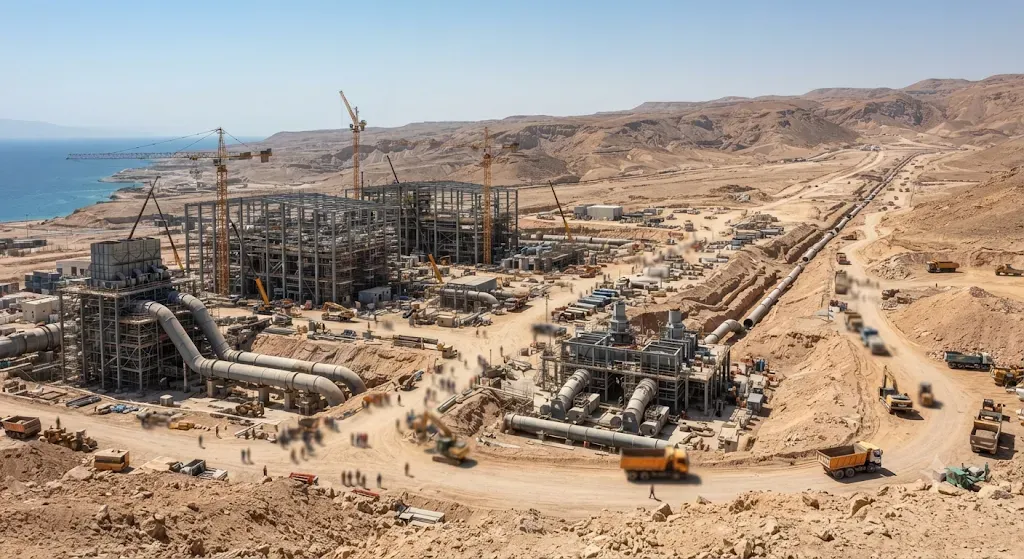
JORDAN —Construction has officially started on the Aqaba-Amman water desalination and conveyance infrastructure scheme in Jordan, following a groundbreaking ceremony attended by Prince Faisal bin Al Hussein, Jordanian Minister of Water and Irrigation Raed Abu Al-Soud, and consortium executives. Designed for single-phase delivery over a four-year build schedule, the asset pairs a desalination plant capable of producing 851,000 cubic meters of water per day along the Gulf of Aqaba with a 418-kilometer conveyance pipeline running north to Amman. Meridiam and SUEZ lead the development under a 30-year concession agreement representing more than USD 6.7 billion in capital investment, while Orascom Construction and SUEZ participate in separate engineering, procurement, and construction joint ventures for the plant and pipeline, followed by a 26-year operations and maintenance mandate.
Water scarcity remains one of Jordan's most pressing structural constraints on economic growth, urban expansion, and public service reliability. By routing treated seawater from the southern coast to the capital region, the system is projected to meet water needs for approximately 40% of Jordan's population, reducing acute supply deficits and lowering long-term reliance on stressed inland groundwater basins. Large-scale desalination and long-distance pumping networks also carry substantial energy demands, making power integration, tariff structures, and lifecycle asset management central determinants of long-term operational viability.
For regional engineering, water treatment, and utility sectors, the project underscores a shift toward multi-decade public-private partnerships and integrated design-build-operate structures for high-capex municipal utilities. It highlights heightened sovereign emphasis on climate-resilient water security and long-term concession financing across arid markets in the Middle East. Orascom Construction is a dual-listed engineering, contracting, and infrastructure investment group active across the Middle East, Africa, and the United States, with a regional water portfolio exceeding 17 million cubic meters per day in combined capacity.
For project sponsors, institutional investors, and equipment suppliers, breaking ground moves a flagship Middle Eastern water concession from structuring into execution, testing cost control, supply chain coordination, and schedule discipline over a four-year build window. Long-term revenue visibility over a 26-year operating phase and 30-year concession attracts infrastructure capital seeking contracted utility cash flows, while simultaneously exposing developers and EPC partners to construction inflation, cross-border procurement risks, and regulatory execution in large-scale sovereign concessions.