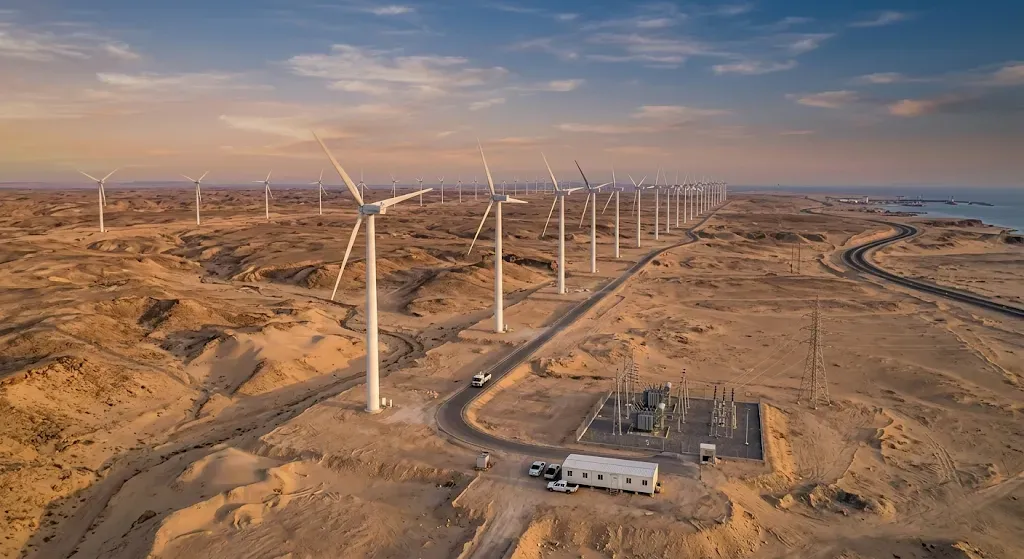
EGYPT —Toyota Tsusho Corporation has committed to participating in an independent power producer wind initiative within Egypt, marking its third and largest venture of this classification in the nation. The enterprise involves the construction, ownership, and operation of a 900-megawatt wind power facility situated in the Gulf of El Zayt region. Operations for the infrastructure are structured through a collaborative local operating entity backed by corporate alliances involving AEOLUS, ENGIE, and Orascom Construction. AEOLUS operates as a joint venture between Eurus Energy Holdings Corporation and CFAO SAS. Toyota Tsusho Corporation is a diversified multinational trading enterprise headquartered in Japan, focusing on global commerce, industrial investments, and sustainable infrastructure development.
The facility will integrate eighty-six wind turbines, each possessing a generation capacity of 10.5 megawatts. Phased deployment is scheduled to commence with an initial 300-megawatt trial phase by January 2028, culminating in full commercial operations by September 2028. Output generated by the facility will be routed through a 25-year power purchase agreement with the Egyptian Electricity Transmission Company. Financing structures for the initiative involve multilateral development institutions and international commercial banks, with specific commercial loans receiving insurance coverage through export credit agencies.
This development significantly accelerates corporate decarbonization targets across African markets, aligning with long-term regional strategies to expand clean energy infrastructure. By securing large-scale utility assets, participating stakeholders mitigate future energy deficits caused by rapid economic expansion while addressing national electricity demand through sustainable generation sources. The project contributes substantially to regional environmental objectives by cutting carbon dioxide emissions by approximately 1.5 million tons annually, while producing electricity equivalent to the annual consumption volume of roughly 2.2 million households within the jurisdiction.
For industrial operators, institutional investors, and energy developers, the initiative illustrates the viability of consortium-led utility projects financed through multilateral banking syndicates in emerging markets. The expansion elevates the corporate group's total wind generation capacity in the host country to over 1.8 gigawatts, advancing progress toward a broader target of 3 gigawatts of renewable generation capacity across the African continent by 2030. Market participants can utilize these deployment models to navigate regulatory frameworks, secure long-term utility revenue streams, and mitigate capital expenditure risks in large-scale infrastructure investments.