UNITED KINGDOM —A GBP 15.7 million research initiative managed by the Advanced Research and Invention Agency (ARIA) will test wireless power transfer capabilities on uncrewed stratospheric platforms to resolve seasonal operational limits in high-latitude environments.
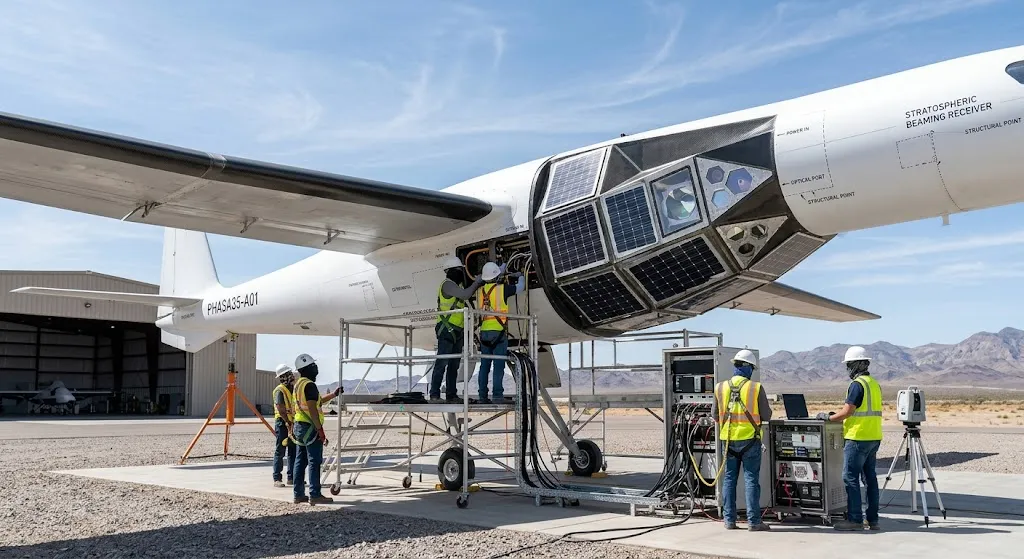
Prismatic, a subsidiary of aerospace firm BAE Systems, will adapt its solar-powered PHASA-35 platform to receive directed energy beams from ground stations during a three-and-a-half-year, three-phase testing program. The platform features a 35-meter wingspan, weighs 150 kg, operates at altitudes exceeding 66,000 feet, and supports up to 15 kg of sensor or communications equipment. BAE Systems is a UK-based global defense, security, and aerospace enterprise specializing in advanced military hardware and autonomous aerial systems.
Current high-altitude pseudo-satellites rely on photovoltaic panels, restricting flight duration during northern winter conditions due to shortened daylight hours and low sun angles. Supplying continuous energy via specialized wing-mounted microwave receivers enables round-the-clock power replenishment. This mechanism reduces internal battery requirements, liberating additional payload capacity for tactical equipment.
Successful implementation of directed energy transmission lowers operational expenses relative to satellite constellations, offering flexible surveillance and communication services. The framework provides continuous intelligence capabilities for defense contractors, telecommunication operators, and Earth observation firms without requiring frequent platform rotations.
From an industry perspective, establishing reliable stratospheric flight supports emerging markets for persistent low-altitude connectivity and intelligence gathering. The project highlights growing public sector investments in alternative airborne communications infrastructure to complement existing satellite systems.