
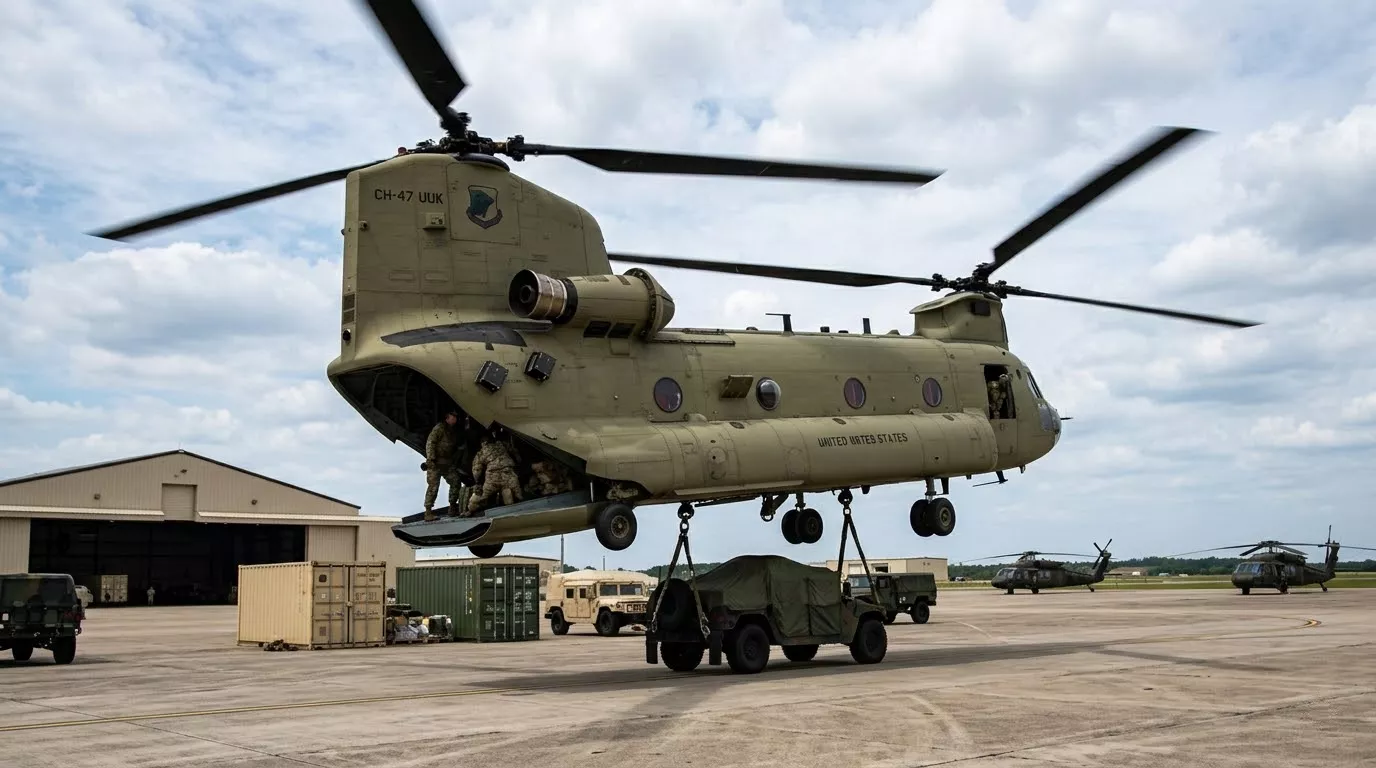
The US Army has awarded Collins Aerospace a contract worth up to $472 million to deliver engineering services and avionics upgrades for the CH-47 Chinook fleet, supporting open architecture and fleet sustainment across defense operations.
The United States Department of Defense has finalized an agreement granting Collins Aerospace a contract potential reaching $472 million to deliver engineering capabilities for the U.S. Army's heavy-lift helicopter platform. Under the multi-year task order, the defense supplier will oversee advanced avionics upgrades, subsystem integration, and life-cycle sustainment for the CH-47 Chinook fleet. Primary technical operations and program execution are scheduled to take place across facility locations in Huntsville, Alabama, and Cedar Rapids, Iowa. Collins Aerospace, an operating segment of RTX Corporation, is a major provider of aerospace and defense solutions, specializing in avionics, flight controls, mission systems, and aircraft interior systems for commercial and military operators worldwide.
This capital allocation addresses crucial technological obsolescence within military aviation cockpits by replacing legacy hardware with modular, high-capacity mission architecture. By embedding updated navigation, secure communications, and flight control subsystems, the initiative ensures operational readiness for rotary-wing assets operating in increasingly contested electromagnetic environments. Modernizing mission electronics extends the service life of existing airframes, allowing defense planners to maintain operational readiness without incurring the capital expense of full fleet replacement.
From an industry and defense policy perspective, the contract underscores the military's shift toward open systems architecture across air defense platforms. Standardizing software interfaces and hardware modules enables faster software deployments and reduces cross-platform integration costs across military aviation branches. This architectural standardization establishes a scalable framework for future capabilities, allowing third-party defense contractors and software vendors to integrate emerging autonomous and sensor technologies without rebuilding flight systems.
For defense prime contractors and Tier 1 suppliers, the award highlights a growing reliance on software-driven sustainment and avionics lifecycle management as core revenue drivers. As defense procurements increasingly prioritize interoperability and hardware independence, aerospace manufacturers positioned in open-architecture engineering stand to secure recurring, high-margin defense services contracts. Furthermore, regional defense technology hubs in Iowa and Alabama continue to consolidate high-skilled engineering talent and defense industrial capacity, reinforcing regional economic stability amid shifting defense spending priorities.
As defense procurement mechanisms adapt to rapid technological evolution, long-term engineering agreements provide established aerospace vendors with steady cash flow visibility while securing critical defense supply chains. The integration of modular avionics into legacy platforms serves as an operational benchmark for defense modernization strategies globally.
About GlobeNewsInfo
GlobeNewsInfo.com is a business news platform providing latest updates on global business developments, projects, and contract opportunities across diverse sectors and regions. The platform is designed to serve as a trusted source of information for companies, investors, and professionals worldwide.