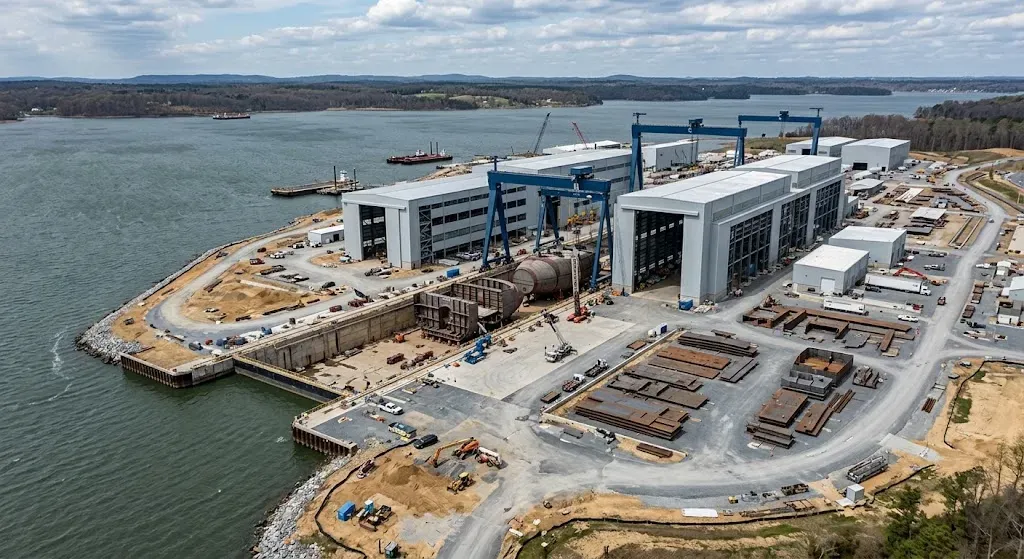
UNITED STATES OF AMERICA —A combined $6.6 billion capital effort is set to expand the U.S. naval defense base through a public-private framework designed to increase production for the Virginia-class submarine program. Under the agreement, defense technology firm Anduril Industries is directing $3.7 billion in private capital toward a new manufacturing site in Sparrows Point, Maryland, designated as Arsenal-2. Concurrently, the U.S. Navy has awarded the firm a performance-contingent contract valued at up to $2.9 billion, tying government outlays directly to demonstrated manufacturing outcomes and shifting operational risks away from public funds.
Anduril Industries is an American defense technology manufacturer that specializes in autonomous systems, software-defined hardware, and advanced manufacturing platforms for military applications. The U.S. Navy is the maritime service branch of the United States Armed Forces, responsible for naval warfare and maintaining maritime security across global waterways.
The expansion targets structural production shortfalls within the defense industrial pipeline. Virginia-class attack submarines, traditionally assembled by prime contractors General Dynamics Electric Boat and Newport News Shipbuilding, face heightened demand driven by domestic force requirements and international obligations under the AUKUS defense pact. By manufacturing large-scale sub-assemblies and complex components independently, the new facility allows critical industrial processes to execute in parallel, relieving downstream bottlenecks at primary integration shipyards.
Operations at the Sparrows Point facility will leverage an integrated software environment to streamline fabrication, material tracking, and quality control workflows across a two-million-square-foot footprint. To prepare for operational status by 2030, primary qualification workflows and prototyping are being initiated at a dedicated facility in Orange County, California, ensuring technical standards are established prior to full-scale deployment in Maryland.
The initiative signals a broader transition toward software-integrated, performance-linked procurement models within military contracting. Regionally, the project establishes Maryland as a central hub for heavy defense manufacturing, generating more than 3,000 direct industrial jobs and stimulating substantial supply chain activity across maritime engineering, steel fabrication, and advanced logistics networks.